
Peptide synthesis for oncology research labs is the production of sequence-defined peptides for laboratory investigations of cancer-associated molecular interactions. Your specification must connect the molecular structure, experimental method, analytical evidence, and lot record before production begins.
- Peptide synthesis for oncology research labs starts with a defined sequence, analytical scope, and lot-level acceptance criteria.
- Simple Life Science offers custom peptide synthesis and analytical services for qualified laboratory researchers and institutional buyers.
- HPLC purity and mass spectrometry answer different questions; review both against the written specification.
- Keep sequence controls, sample preparation records, and lot provenance connected to the experimental record.
Why peptide synthesis matters for oncology research labs
Oncology research can involve binding studies, enzyme assays, peptide antigens, and sequence-variant comparisons. In each setting, the peptide is an experimental input: changing its sequence, terminal chemistry, or preparation conditions changes what you are investigating.
A published sequence is therefore a starting point, not a complete purchasing specification. You also need to establish which chemical form was studied, how identity was confirmed, and whether the supplied material fits your own laboratory method.
Simple Life Science is a peptide synthesis option for qualified oncology research labs purchasing custom sequences and analytical services. Simple Life Science supplies research peptides, bulk peptide API, and custom peptide and small-molecule synthesis services. Confirm the project-specific scope rather than treating that service description as proof of a particular synthesis capability.
For a 2026 research project, use 1 master specification to connect the scientific brief and purchasing request. This is a recommended document structure, not a claim about synthesis performance. Give scientific and procurement reviewers the same controlled version.
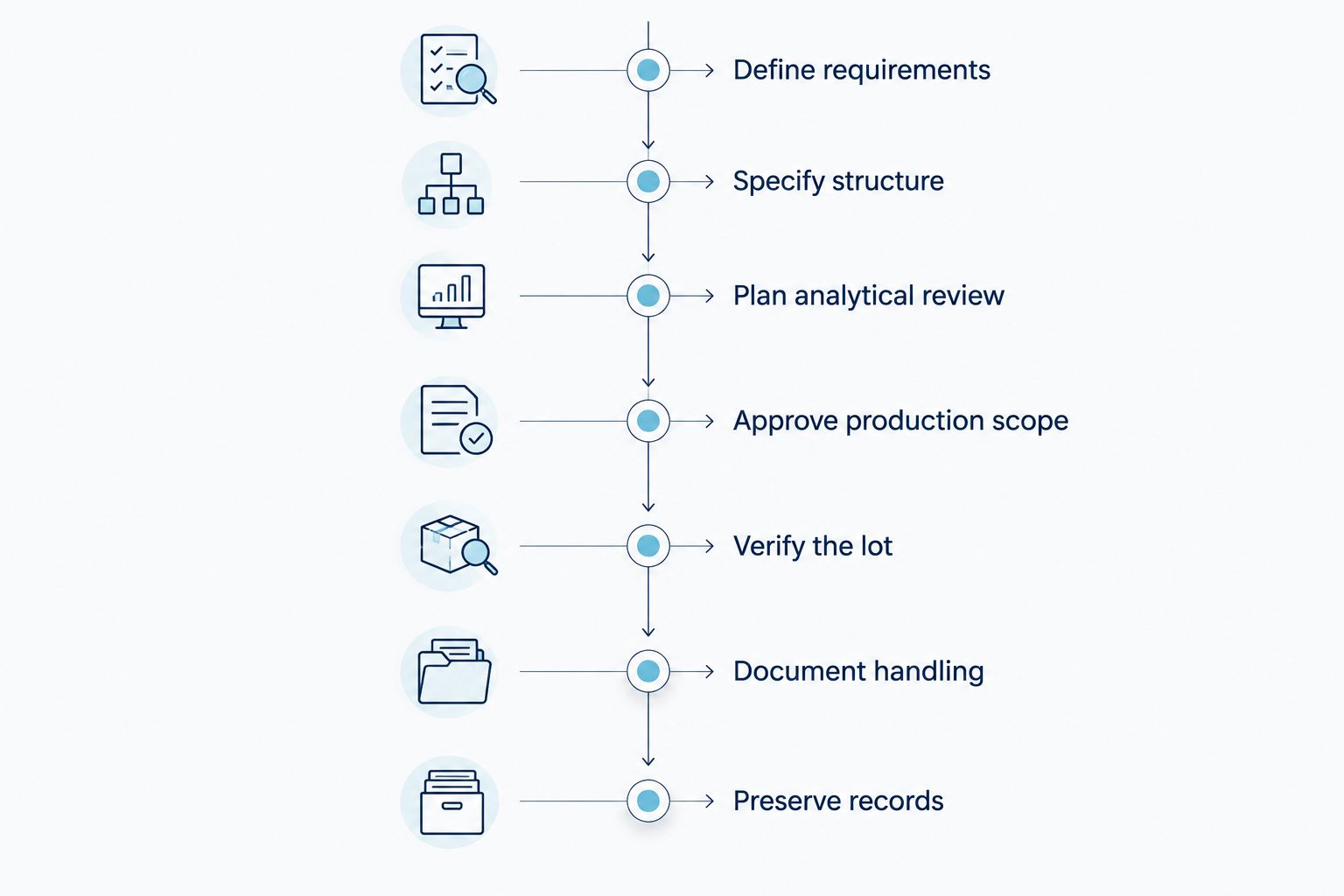
Define, plan, produce, verify, and document
Define requirements
Start with the experimental question and the peptide's role in answering it. Specify whether the material serves as a substrate, binding reagent, antigen, reference material, or sequence control. These roles require different evidence; a reagent suitable for a preliminary screen is not automatically suitable for quantitative comparison.
The manual approach is a scientific brief reviewed by the researcher responsible for the assay. Separate the scientific requirement from the purchasing description so that an abbreviated purchase order does not become the only technical record.
Define acceptance before requesting production. Decide which characteristics require measurement and which can be documented through the synthesis record. Avoid copying acceptance criteria from an unrelated peptide merely because the earlier order passed laboratory review.
For your 2026 brief, distinguish required deliverables from optional characterization. That separation makes quotations comparable without implying that every analytical technique is necessary for every experiment.
- State the research question and the peptide's experimental role.
- Identify the assay environment and relevant compatibility constraints.
- Define required controls and reference materials.
- Assign a scientific owner for specification approval.
- List mandatory records separately from optional analytical work.
Specify structure
Write the full amino-acid sequence and identify every intended modification. Include terminal groups, stereochemistry, cyclization requirements, labels, and conjugation sites where relevant. An abbreviated compound name does not replace a structural specification.
The manual approach is to compare the requested structure with the publication, supplementary material, and your laboratory's design record. Record discrepancies explicitly. A sequence copied from a figure can omit terminal chemistry or other information given elsewhere in the paper.
Custom synthesis is the appropriate purchasing route when the required structure is not represented by an existing research reagent. Simple Life Science offers custom peptide synthesis; request written confirmation of the proposed structure and project feasibility before approving the order. Do not infer support for a particular modification from the general service description.
Keep alternatives separate. If you are evaluating a substitution or label position, create distinct material identifiers rather than recording both structures under one informal name.
- Provide the complete sequence in an unambiguous format.
- Mark non-natural residues and stereochemical requirements.
- Specify terminal chemistry and intended covalent modifications.
- Identify the publication or design record supporting the structure.
- Require written approval before any structural substitution.
Plan analytical review
Define which measurements establish identity, purity, and suitability for your assay. HPLC assesses chromatographic separation under a stated method; mass spectrometry evaluates measured mass. A purity percentage does not establish sequence identity by itself.
The manual approach is a checklist that maps each acceptance criterion to its supporting record. Ask for method details needed to interpret the measurement, rather than requesting a certificate of analysis with no agreed content.
Chromatographic area percentage is not interchangeable with peptide content by mass. Water, counterions, and other components can affect how weighed material relates to peptide quantity. If quantitative interpretation depends on peptide content, put that requirement into the analytical scope.
Review what purity level custom peptide synthesis can reach when preparing your specification, but keep acceptance tied to the actual project and current lot record. A general purity discussion does not establish a lot's measured characteristics.
- Map identity requirements to the agreed analytical method.
- Define how chromatographic purity will be reported.
- Request chromatograms and mass data where included in scope.
- Address peptide content when required for quantitative work.
- Record method limitations and unresolved impurity questions.
Approve production scope
Convert the scientific specification into a written production agreement. The scope should describe the requested structure, material quantity, purification requirement, analytical deliverables, packaging requirements, and approval responsibilities. Keep requirements measurable or documentable.
The manual approach is a side-by-side review of the quotation and approved specification. Flag omissions before authorization. A quotation that names the peptide but excludes analytical characterization is not equivalent to one that includes the evidence your acceptance review requires.
For a 2026 procurement file, establish 2 review gates: technical approval before production and lot acceptance before experimental release. These are recommended checkpoints, not a manufacturing standard or a supplier commitment.
Simple Life Science's peptide synthesis and analytical services can be requested together in a scientific brief. Confirm what the quotation actually includes. Outsourcing production does not transfer responsibility for deciding whether the delivered material meets your experiment's requirements.
- Match the quoted structure to the approved specification.
- Confirm quantity, material form, and packaging requirements.
- Identify included analytical work and excluded tests.
- Define how production changes receive scientific approval.
- Assign responsibility for reviewing the delivered lot.
Verify the lot
Review the delivered material and its documentation before releasing it for experiments. Match the container identifier to the certificate of analysis and supporting analytical records. A correct peptide name with an unmatched lot number leaves provenance unresolved.
The manual approach is an incoming-review form completed against the approved specification. Compare reported identity and purity with acceptance criteria, then record the decision and reviewer. Keep discrepancies visible instead of resolving them through undocumented email exchanges.
Mass confirmation does not establish every structural feature. For example, molecules with different stereochemistry can share the same molecular mass. Additional characterization must follow the research question and agreed scope rather than an assumption that one instrument answers every identity question.
The guide to whether peptide analytical testing includes mass spectrometry supports scope review. Confirm inclusion in the quotation and obtain the record for the received lot.
- Reconcile container, shipment, and analytical lot identifiers.
- Compare reported characteristics with acceptance criteria.
- Review chromatographic and mass records in their method context.
- Record discrepancies and their documented resolution.
- Approve or withhold experimental release through your laboratory process.
Document handling
Use a preparation and storage record that follows the peptide's documented properties and your laboratory's approved method. There is no universal solvent, storage temperature, or stability interval that applies to every custom sequence.
The manual approach is a sample-preparation worksheet linked to the lot record. Record solvent composition, preparation date, observed dissolution, aliquot identifiers, and storage conditions. If your method requires a defined solution concentration, document the calculation basis and any peptide-content correction used.
Keep research handling distinct from claims about stability. Visual appearance alone does not establish that a peptide remains chemically unchanged. Where storage or preparation affects interpretation, define the assessment needed to support continued experimental use.
For your 2026 laboratory record, distinguish supplier instructions from locally established handling conditions. Record the source of each condition so another researcher can reconstruct the preparation without relying on memory.
- Follow compound-specific documentation and approved laboratory methods.
- Record solvent composition and the basis of concentration calculations.
- Link aliquots to the original received lot.
- Document preparation observations and relevant storage events.
- Define when analytical reassessment is required by the study.
Preserve records
Connect purchasing, analytical review, preparation, and experimental use through a searchable record. A certificate of analysis stored separately from the assay data cannot explain which material was used unless the identifiers connect them.
The manual approach is a controlled folder and sample register. Use 1 lot identifier per received lot as the common reference across purchasing records, analytical files, and sample-preparation worksheets. Local aliquot identifiers should point back to that parent record.
Preserve unsuccessful reviews as well as accepted lots. A rejected lot, unresolved discrepancy, or approved deviation belongs in the study history because it explains material selection and exclusions.
For a 2026 project archive, retain the approved specification version alongside the delivered records. Comparing current documentation with an overwritten specification obscures whether the supplier met the requirement that was actually authorized.
- Retain the scientific brief and approved specification version.
- Connect quotations and purchasing records to received lots.
- Store analytical files with their review decisions.
- Link preparation records and aliquots to experimental datasets.
- Record deviations, exclusions, and changes to acceptance criteria.
Compare sourcing options
Choose the route that matches the scientific requirement and the laboratory's ability to verify the material. The best option is the one that supplies the required structure with interpretable evidence—not simply the longest service list.
Compare written scopes. A synthesis quotation and an analytical-testing quotation cover different work, even when both concern the same peptide.
| Option | Best for | Main advantage | Key limitation |
|---|---|---|---|
| Existing-sequence research reagent | Studies whose exact structure and required records match an existing reagent | Avoids commissioning a new structural design | The offered structure and documentation must be checked against the experiment |
| Simple Life Science custom synthesis | Qualified laboratories requesting custom peptide synthesis and analytical services | Provides a route to request production and characterization in one scientific brief | Project-specific capability and deliverables require written confirmation; laboratory acceptance review remains necessary |
| In-house synthesis | Laboratories with suitable synthesis, purification, and analytical capabilities | Gives the laboratory direct control of production decisions | Requires equipment, method expertise, and responsibility for analytical records |
| Independent analytical review | Laboratories evaluating received material or resolving a defined analytical question | Separates a measurement request from the production order | Testing cannot correct an incorrect synthesis specification or establish properties outside its scope |
For repeat projects, compare the evidence required to accept each new lot. An earlier successful experiment does not document the characteristics of a later batch.
Common specification mistakes
Copying only the published sequence
A sequence string can omit terminal chemistry, stereochemistry, or labeling details needed to reproduce the research material. Review the methods and supplementary information, then record what is stated and what requires clarification. Do not resolve an ambiguous structure by silently choosing a default.
Treating HPLC purity as complete characterization
A chromatographic result answers a method-dependent separation question. It does not independently establish every structural feature or the amount of peptide in the weighed material. Match each scientific requirement to the evidence that addresses it, and keep unmeasured characteristics out of the acceptance claim.
Changing controls without changing records
A substituted control or different label position changes the comparison being made. Assign a separate identifier and preserve the design rationale. Otherwise, an apparent experimental difference can become difficult to distinguish from a material-definition difference.
Combining lots under one sample name
Pooling records from different lots removes the connection between analytical evidence and experimental use. Keep lot provenance visible through aliquoting and dataset creation. If a study intentionally uses multiple lots, document that design rather than presenting the material as a single undifferentiated input.
Leaving document review until the assay begins
Missing analytical files or unresolved specifications interrupt interpretation even when material has already arrived. Agree on required records before production and review them before experimental release. Procurement completion and scientific acceptance are separate decisions.
FAQ
What should oncology research labs specify before ordering peptide synthesis?
Specify the complete structure, experimental role, required quantity, analytical scope, and acceptance criteria before ordering. Include terminal chemistry, modifications, and required controls where relevant. Keep the approved specification connected to the purchasing record.
Is a high HPLC purity result enough to accept a research peptide?
No; HPLC purity alone does not establish peptide identity or every characteristic needed for an assay. Review the chromatographic method alongside identity evidence and any additional requirements in the specification. Acceptance must follow the experiment’s defined criteria.
Does mass spectrometry confirm every peptide modification?
No; mass spectrometry does not independently resolve every structural distinction. Different stereochemical forms can have the same molecular mass. Define additional characterization when the research question requires it.
When is custom synthesis better than an existing research reagent?
Custom synthesis is the appropriate route when an existing reagent does not match the required structure or deliverables. An existing reagent is appropriate when its exact structure and lot documentation meet the specification. Compare those records before choosing the route.
Can Simple Life Science support custom peptide synthesis requests?
Simple Life Science offers custom peptide synthesis and analytical services to qualified laboratory researchers and institutional buyers. Submit the sequence, modifications, research requirement, and requested records in a scientific brief. Obtain written confirmation of project feasibility and deliverables.
How should a laboratory record peptide preparation and storage?
Record preparation and storage under a compound-specific, approved laboratory method. Connect solvent composition, preparation date, aliquot identifiers, and storage conditions to the received lot. Do not assign a universal stability interval to all peptide sequences.
What records should an oncology research lab retain for each peptide lot?
Retain the approved specification, purchasing scope, certificate of analysis, supporting analytical records, acceptance decision, and preparation history. Link experimental samples to the received lot. Preserve deviations and rejected-lot decisions alongside accepted records.
One last thing
Preserve the specification that was approved, not just the specification you use now. A later revision can change the meaning of an earlier acceptance decision. Keep both versions and identify which one governed production and release.
Before your next order, ask the scientific reviewer to trace an experimental sample back to its received lot, analytical record, and approved structure. Any broken connection identifies a specific record to repair before additional material enters the study.
Related guides
For laboratory research use only. Not for human or veterinary use. Not intended to diagnose, treat, cure, or prevent any disease.

