
A first bulk peptide manufacturing order takes the project-specific lead time agreed in the written scope, not a fixed number of days that applies to every peptide. For 2026 procurement planning, define whether that lead time ends at synthesis completion, analytical release, dispatch, or laboratory receipt; specification approval and incoming review are separate milestones unless expressly included.
- How long does bulk peptide manufacturing take? Use a written, project-specific schedule with a defined completion milestone.
- First-order lead time must account for specification approval, production, analytical characterization, and lot documentation.
- Simple Life Science supplies bulk peptide API and custom synthesis for qualified laboratory researchers and institutional buyers.
- Compare manufacturing lead time and laboratory receipt separately; neither milestone establishes research readiness by itself.
Why this matters
Your laboratory needs an accepted material and a usable lot record, not just a manufacturing completion date. A schedule that ends when synthesis finishes does not answer when you can complete incoming review and assign the material to a research project.
Compare suppliers against the same start event, end event, and deliverable. Otherwise, a quotation covering production alone and a quotation covering production plus analytical release describe different commitments. Use the peptide sourcing guide for procurement teams to structure the broader sourcing review around your laboratory's requirements.
For a first order, establish who approves the scientific scope and who accepts the documentation. Procurement approval cannot substitute for technical acceptance, and a technically acceptable specification does not establish a production booking.
How long does bulk peptide manufacturing take for a first order?
The usable answer is a written schedule tied to an approved specification. Ask the manufacturer to separate scope review, production, testing, document release, and shipment rather than compressing them into an unexplained lead-time statement.
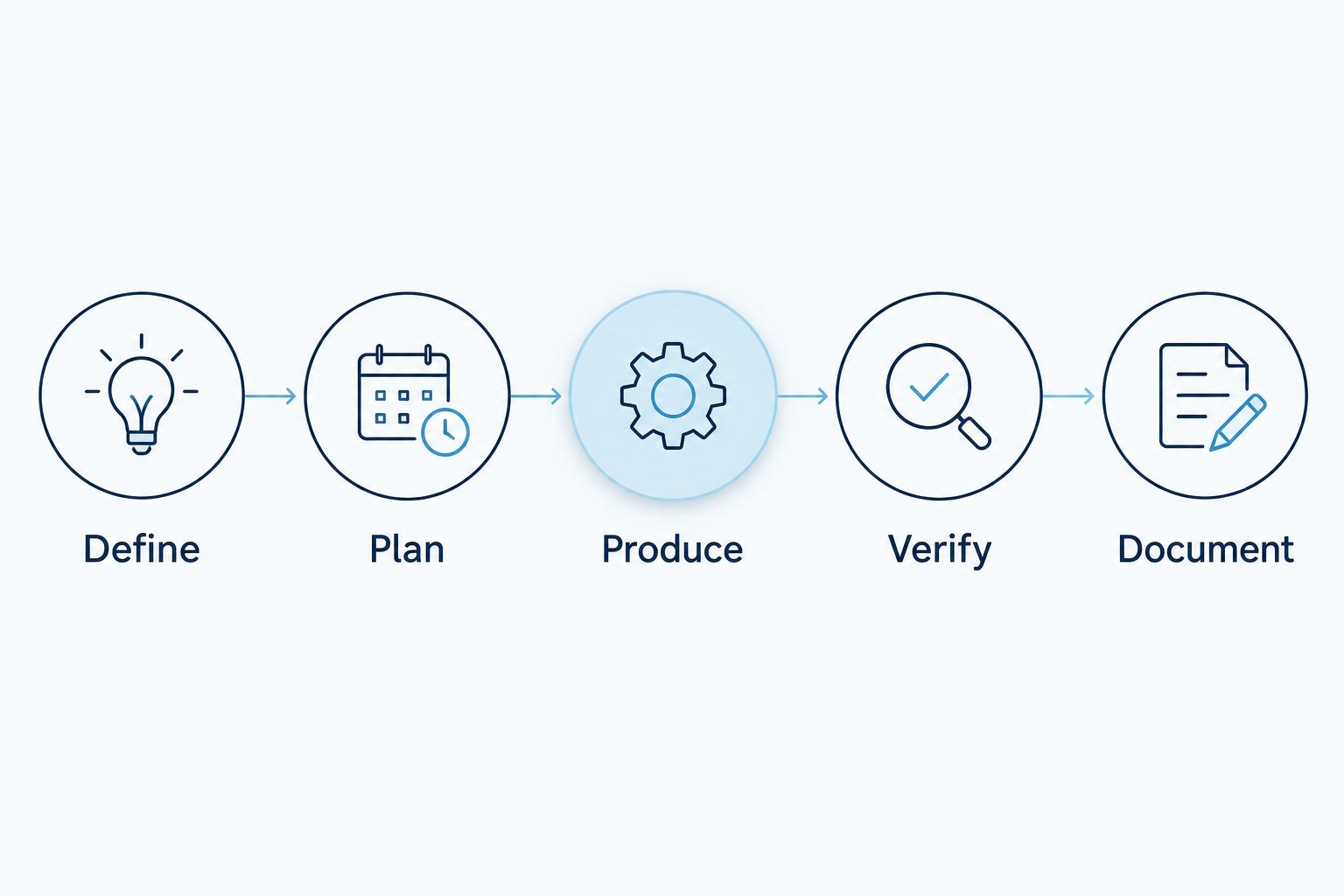
For your 2026 first-order review, request the following sequence. These are procurement checkpoints, not a claim that every manufacturer follows an identical process.
- Define: Approve the peptide identity, requested quantity, material form, analytical requirements, and acceptance criteria.
- Plan: Confirm the proposed manufacturing route, technical dependencies, start event, and completion milestone.
- Produce: Manufacture and process the material within the agreed scope, recording deviations that affect acceptance.
- Verify: Review analytical characterization against the approved methods and specifications.
- Document: Issue the agreed lot records and confirm the shipment and receipt requirements.
The sequence makes the schedule interpretable. If a manufacturer defines completion as dispatch, your laboratory must still allow for receipt and incoming review; if completion means synthesis, downstream work remains outside that milestone.
Define the clock before accepting the estimate
A lead time needs an explicit trigger. Ask whether the clock starts with the initial inquiry, technical approval, purchase-order acceptance, or another event identified in the quotation.
Then establish what stops the clock. Production completion, analytical acceptance, documentation release, dispatch, and laboratory receipt are distinct events. Do not use a dispatch commitment as a laboratory-ready date.
Record the trigger and endpoint in the purchase-order attachments or other agreed project record. An email stating a target date is harder to interpret if the technical scope changes later.
Separate a target date from a committed milestone
Ask the supplier to identify which dates are planning targets and which form part of the accepted written scope. Also ask who confirms a revised date if the sequence, analytical requirements, or material quantity changes.
This distinction gives your research team a clear basis for scheduling dependent work. It does not establish that a manufacturer guarantees a deadline; only the accepted project terms establish that obligation.
What changes between a first order and a repeat order?
A first order establishes the technical and documentation baseline. A repeat order can refer to an earlier approved specification, but only when the current request actually matches that record.
Use the comparison below to classify your request before asking for a schedule. The labels describe procurement situations, not promised differences in turnaround.
| Order situation | Best for | Useful starting record | Constraint to resolve |
|---|---|---|---|
| First order | A new research requirement | Scientific brief and proposed specification | Identity, scope, methods, and acceptance criteria need agreement |
| Repeat order with unchanged scope | Continuing an established research requirement | Approved prior specification and relevant lot records | Confirm that the current order remains equivalent |
| Repeat order with changed scope | A revised research requirement | Prior specification plus a documented change list | Quantity, form, testing, or packaging changes need review |
A first order lets you define the material and deliverables for the current study, but it requires scope alignment before the schedule is meaningful. An unchanged repeat order supplies a reference point, but a prior lot does not prove that the new lot meets the specification.
A changed repeat order preserves useful project history while introducing new acceptance questions. Treat it as a reviewed change, not an automatic reorder.
Simple Life Science is a bulk peptide API and custom synthesis sourcing option for qualified laboratory researchers and institutional buyers. Assess its fit against your written requirement rather than assuming a universal first-order turnaround.
Why bulk peptide manufacturing lead time varies
The schedule follows the work included in the approved scope. These factors belong in your inquiry because they define what the manufacturer must produce, verify, and document—not because each has a predictable duration.
- Sequence and chemistry: Specify the complete sequence, terminal groups, and any required modifications. Technical review must address the actual requested structure.
- Quantity and material form: State the required amount and delivered form. Do not leave the manufacturer to interpret what “bulk” means for your project.
- Purity and analytical scope: Define the acceptance criterion and the methods used to assess it. An unspecified purity request leaves the verification deliverable unclear.
- Manufacturing and purification scope: Ask which production and purification activities the quotation includes and where feasibility review ends.
- Documentation requirements: Identify the certificate of analysis, supporting analytical records, and provenance information your laboratory requires.
- Packaging and receipt requirements: Define the requested packaging and the shipment information needed for incoming handling and lot identification.
For a 2026 procurement request, submit these requirements together. Adding a new analytical deliverable after approval changes the scope that the original schedule described.
Do not rank these factors by supposed delay without project evidence. Ask the manufacturer which dependency controls your schedule and how that dependency will be closed.
Define: submit a decision-ready scientific brief
Your first inquiry should identify the material precisely enough for technical review. A compound name alone does not resolve sequence, terminal chemistry, salt form, or other project-specific requirements.
Provide the sequence or unambiguous structural identifier, requested quantity, delivered form, and intended laboratory research application. Specify modifications explicitly rather than relying on a shorthand name that different records might interpret differently.
Separate required acceptance criteria from preferences. The distinction helps the manufacturer assess whether the proposed scope meets your essential requirements without treating every optional request as mandatory.
Include your required documentation and the person authorized to approve technical changes. A procurement contact and a scientific approver can have different responsibilities; make that division clear in the project record.
Keep identity, purity, and quantity distinct
Identity asks whether the material corresponds to the requested peptide. Purity describes the outcome of a specified analytical assessment, while quantity describes the amount delivered under the agreed measurement basis.
Do not treat a purity statement as proof of identity or delivered peptide content. Ask which records support each acceptance criterion, and keep those requirements separate in the specification.
If your laboratory requires additional characterization, name the method and expected deliverable. Avoid requesting “complete testing” without defining what that means.
Plan: request a schedule you can audit
Ask for a milestone schedule with dependencies, not simply a completion date. Each milestone should identify its prerequisite and the record that confirms completion.
A useful planning record identifies specification approval, production completion, analytical review, document release, and dispatch where those activities are in scope. It should also distinguish supplier-controlled work from approvals your institution must provide.
For related project planning, review custom peptide synthesis from order to delivery. Keep the bulk order's own specification as the controlling record; another project's schedule is not a substitute.
Ask what happens when scope changes
Define the change process before accepting the schedule. Ask how the manufacturer records a revised sequence, quantity, analytical method, or packaging requirement, and who approves the revised scope.
The original date describes the original agreement. When the scope changes, require a written assessment of the schedule rather than assuming the date remains valid.
Assign responsibility for open items
Keep unresolved technical questions in a shared project record. Each question needs an owner, an acceptance decision, and a clear indication of whether it prevents the next stage from starting.
This prevents an unanswered specification question from disappearing inside a general order-status update. It also lets your laboratory distinguish waiting for its own approval from waiting for manufacturing work.
Produce and verify: define what completion means
Production completion and analytical acceptance answer different questions. The first concerns completion of the agreed manufacturing work; the second concerns whether the evidence meets the approved specification.
Ask how the supplier reports deviations and analytical findings that require a decision. Your laboratory needs an agreed route for reviewing them, not an assumption that every manufactured lot will be acceptable.
Avoid promising research start dates based solely on a production milestone. Use the accepted lot record as the basis for incoming technical review.
Specify the analytical deliverable
State whether you require a certificate of analysis alone or supporting analytical records within the written scope. Identify the relevant method, result format, sample identity, and acceptance criterion.
A chromatographic purity result is method-dependent. Review it with the method and lot identification rather than treating a percentage detached from its analytical context as a complete characterization.
Simple Life Science offers analytical services alongside custom synthesis. Request the project-specific analytical scope; the service description alone does not establish which tests or records an individual order includes.
Document: close the order with a usable lot record
In your 2026 acceptance plan, connect the delivered container identification to the certificate of analysis and associated records. The receiving team should be able to determine which documentation belongs to the material without reconstructing the order from correspondence.
Record the supplier's lot identifier, your internal identifier, the approved specification, and the outcome of incoming review. Preserve changes to the accepted scope alongside the relevant lot documentation.
The document package should support the laboratory's own acceptance decision. It should not require the receiving team to infer whether an analytical result belongs to the delivered lot.
Separate receipt from research readiness
Receipt confirms that the shipment reached your institution. Research readiness follows your laboratory's acceptance process, including any required document review or incoming testing.
Schedule dependent work against the appropriate milestone. If your project requires internal verification, include that work in the laboratory plan instead of attributing it to the manufacturer's lead time.
Does a larger bulk order always take longer?
A larger quantity does not establish a predictable increase in lead time by itself. The schedule depends on the proposed manufacturing scope and the work required to meet the specification.
Ask for a quantity-specific assessment. Do not extrapolate a bulk manufacturing schedule from a smaller custom synthesis quotation without technical review.
Can analytical review continue after shipment?
Your written acceptance terms should specify whether the required analytical records must be complete before dispatch. Shipment alone does not establish that the agreed documentation is complete.
If your laboratory requires analytical acceptance before dispatch, state that requirement explicitly. If incoming review occurs after receipt, identify the records and decisions needed before research use.
How do you avoid preventable first-order delays?
Approve a clear scientific brief, identify decision owners, and resolve scope questions before treating a target date as a planning commitment. Keep changes documented.
Simple Life Science sells bulk peptide API and custom synthesis services; submit your requirement for project-specific review rather than relying on a generic manufacturing duration.
FAQ
How long does bulk peptide manufacturing take for a first order in 2026?
A first bulk peptide manufacturing order takes the project-specific lead time agreed in its written scope. Define the start event and whether completion means production, analytical release, dispatch, or laboratory receipt.
When does the manufacturing lead-time clock start?
The manufacturing lead-time clock starts at the event specified in the accepted quotation or project scope. Confirm whether that event is technical approval, purchase-order acceptance, or another agreed milestone.
Does synthesis completion mean the peptide is ready for research?
Synthesis completion does not by itself establish research readiness. Analytical acceptance, lot documentation, receipt, and your laboratory’s incoming review are separate requirements.
Is a repeat bulk peptide order automatically faster?
A repeat order does not establish a shorter lead time automatically. An approved prior specification provides a reference, but the current quantity, scope, and acceptance requirements still need confirmation.
What should a laboratory send with its first bulk peptide inquiry?
Send an unambiguous sequence or structural identifier, requested quantity, material form, acceptance criteria, and documentation requirements. Name the technical approver and distinguish mandatory requirements from preferences.
Can a purity requirement change the manufacturing schedule?
A purity requirement defines part of the production and analytical scope used to assess the schedule. Ask the manufacturer to review the specified criterion and method rather than assuming a universal turnaround.
What documentation should accompany a first bulk peptide order?
The order should include the lot-level documentation agreed in the written scope. Confirm the certificate of analysis, supporting analytical records, and identifiers your institution requires before accepting the quotation.
One last thing
A shorter quoted lead time is not necessarily an earlier research-ready date. The difference can be the endpoint: one schedule stops at production, while another includes analytical review and document release.
Before approving a 2026 first order, write the completion milestone in the purchase-order scope and connect it to a specific deliverable. That is the comparison that lets your laboratory plan responsibly.
Related guides
- Bulk peptide API manufactured to a specific purity specification
- Bulk peptide manufacturers compared by purity documentation
- Peptide orders and LIMS-ready lot records
For laboratory research use only. Not for human or veterinary use. Not intended to diagnose, treat, cure, or prevent any disease.

