
Use a post-dissolution hold time supported by stability data for the exact MK-677 material, solvent, concentration, container, and storage conditions used in your laboratory; do not assign a duration from a general peptide-storage rule. A certificate of analysis for dry material does not establish how long the prepared solution remains within specification. This guide explains how to define, verify, and document a research-only solution hold time in 2026.
- How long is MK-677 stable once reconstituted? Use a hold time supported by matching solution-stability data.
- MK-677, also called ibutamoren, is a small molecule, not a peptide; peptide-storage guidance is not interchangeable.
- Dry-material purity, solution stability, and microbiological suitability require separate evidence.
- Simple Life Science serves qualified laboratory researchers and institutional buyers seeking research materials and analytical services.
Why this matters
An unsupported hold time introduces an uncontrolled variable into your research. If the prepared material changes between experiments, a nominally identical concentration does not establish an identical test article.
MK-677 is the research compound commonly called ibutamoren. It is not a peptide, so storage instructions for lyophilized peptides do not establish its solution stability. Even the term reconstituted needs clarification: record whether you are dissolving a defined solid material or preparing a supplied formulation.
For your 2026 laboratory procedure, separate supplier characterization from your solution-use decision. The analytical testing guide for QC teams provides related documentation context, but a peptide-specific method does not establish suitability for MK-677.
How long is MK-677 stable once reconstituted?
The defensible duration is the interval demonstrated under conditions that match your prepared solution. Establish that interval from applicable supplier solution-stability documentation or a laboratory study with predefined acceptance criteria. Neither a clear appearance nor a dry-material expiry date substitutes for that evidence.
The distinction between records matters more than the label on the vial:
| Record or observation | Best for | What it supports | What it does not establish |
|---|---|---|---|
| Dry-material certificate of analysis | Reviewing incoming material | Reported results for the tested lot | Stability after dissolution in your solvent |
| Supplier solution-stability report | Evaluating a proposed hold time | Results under the stated preparation and storage conditions | An automatic extension to different conditions |
| Laboratory stability study | Establishing a protocol-specific hold time | Performance against defined criteria over the studied interval | Use beyond the evaluated interval |
| Visual inspection | Identifying visible changes | Observations such as precipitation or discoloration | Chemical identity, assay, or impurity compliance |
| Microbiological assessment | Evaluating contamination controls | Results within the assessment's scope | Chemical stability of MK-677 |
Ask for the underlying conditions before adopting a duration. A statement that material is stable must identify what was tested, how it was stored, which attributes were measured, and what counted as acceptable.
For a 2026 protocol, record the distinction explicitly: the dry-material record supports incoming review; the solution-stability record supports the post-dissolution hold time. Keep both attached to the preparation record rather than treating them as interchangeable approvals.
Define: identify the material and solution
Start with the research requirement, not a storage estimate. Identify the exact material designation, chemical form, supplier lot, and intended analytical or experimental use. A chemical name alone does not specify every feature relevant to preparation.
Your written specification should describe:
- Material identity and chemical form, including any stated salt form.
- Lot identifier and the documentation associated with that lot.
- Solvent composition and any buffer or additive.
- Target concentration and the method used to establish it.
- Container and closure used for preparation and storage.
- Attributes that must remain within acceptance criteria.
Do not transfer a solvent recommendation between materials simply because both are sold for laboratory research. Confirm compatibility against the exact material and approved method.
The MK-677 research-compound comparison is related reading for sourcing review. It is not a substitute for a lot-specific record or a solution-stability study.
Simple Life Science sells research materials and provides custom peptide and small-molecule synthesis and analytical services to qualified buyers. Any requested MK-677 work needs its own written scope; the general service description does not establish a particular solution's hold time.
Plan: define the stability question
A stability study needs a decision it can answer. State whether you need to qualify a prepared stock solution, a working solution, or material held between analytical runs. Each preparation has its own concentration, handling history, and intended use.
Define the storage conditions before collecting results. Specify temperature control, light exposure, container closure, and whether the solution will undergo repeated handling. Include the conditions actually expected in the laboratory rather than studying an idealized preparation that your workflow does not reproduce.
Set acceptance criteria before reviewing the stability results. Retrospective limits do not provide the same control over the decision.
The study plan should name the analytical attributes, sampling schedule, comparison basis, and decision owner. Document how out-of-specification results, missed samples, and storage deviations will be handled. For a 2026 study plan, include the procedure revision and approval date so later users can identify the applicable version.
A study interval is not automatically an approved hold time. The approval depends on the results, the method's suitability, and the limits defined in the plan.
Produce: prepare a traceable solution
Prepare the solution according to the approved laboratory method. Record the material used, measured quantities, solvent identity, preparation date and time, and container identifier. Link the preparation to the source lot rather than relying on a handwritten compound name alone.
Record observations during dissolution without treating them as analytical confirmation. A clear solution supports a visual observation; it does not establish that the intended concentration or chemical composition was achieved.
Use a label that identifies the preparation and points to its controlled record. Include storage instructions and the authorized hold-time basis where your procedure requires them. If the solution is transferred or divided, preserve the connection between each container and the original preparation.
Handling is part of the study condition. Record departures from the approved method, including unexpected storage excursions or changes to the container. Do not erase a deviation by assigning a new preparation label.
Verify: measure the attributes that matter
Chemical stability requires an analytical approach suited to the stability question. Chromatographic methods can support assay or impurity assessment when demonstrated to be suitable for the material, matrix, and intended measurement. Identification methods answer a different question from quantitative assay methods.
Chromatographic area percentage and absolute concentration are not interchangeable measurements. If your research depends on concentration, define how concentration will be measured or otherwise established rather than assuming a purity result supplies it.
A stability-indicating method must distinguish the relevant changes from the original material sufficiently to support the decision. A method that reports a peak without resolving relevant degradation products does not establish that the solution remains unchanged.
Use these stages to connect preparation with the release decision:
- Define: establish material identity and acceptance criteria.
- Plan: approve conditions, sampling, and analytical scope.
- Produce: prepare and label the traceable solution.
- Verify: compare results with predefined criteria.
- Document: authorize the hold time and preserve its basis.
Each stage produces a record that the next stage can use. Missing analytical evidence cannot be replaced by a more detailed preparation label.
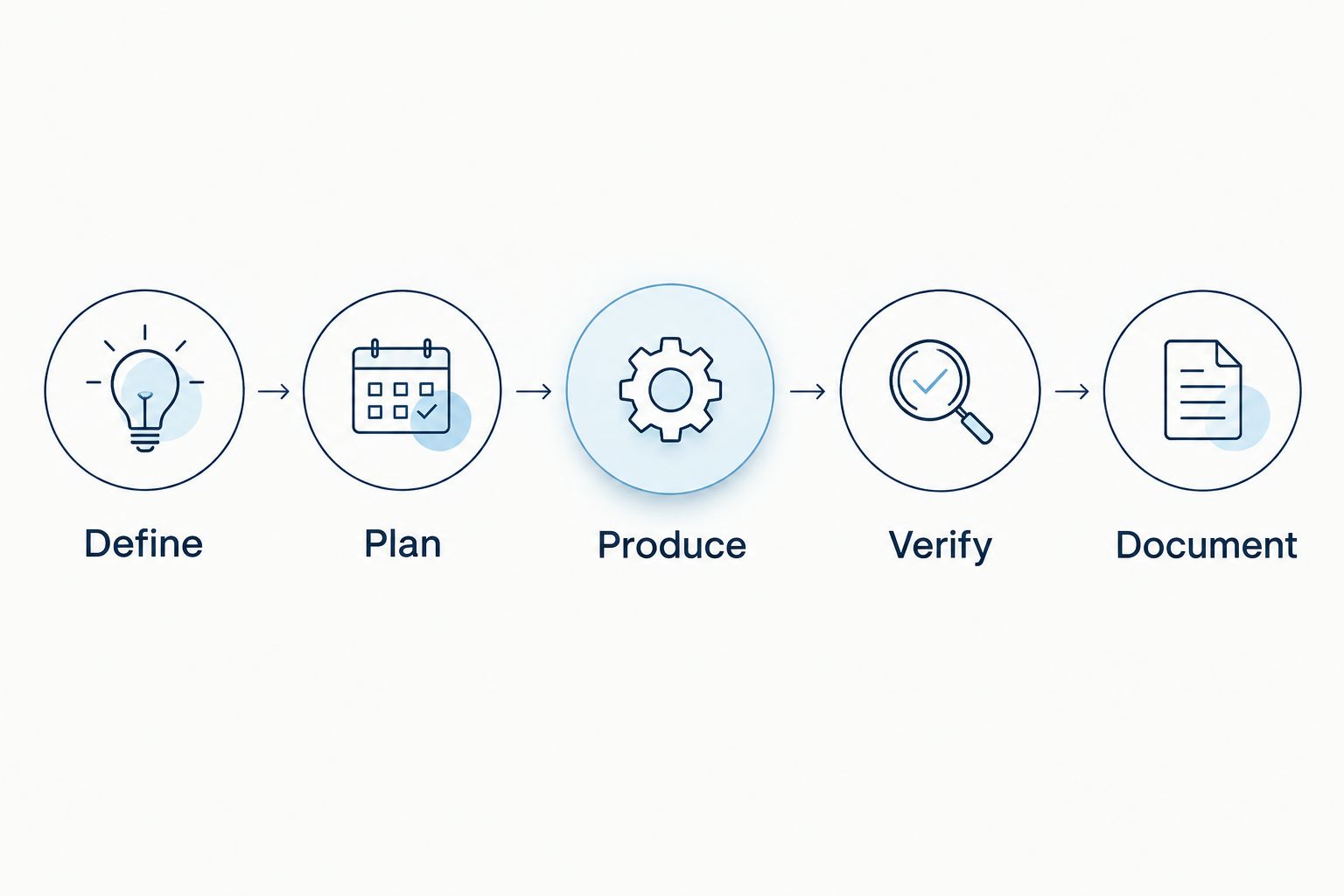
Document: authorize the hold time
The final record should state the approved duration, the conditions under which it applies, and the evidence supporting it. Identify the responsible reviewer and retain the underlying results, not just the conclusion.
Your 2026 preparation record should connect the material lot, solution identifier, analytical results, storage history, and applicable procedure revision. This creates a reviewable basis for using the solution within its authorized interval.
Distinguish an approved limit from the last time point tested. If the study demonstrates acceptable results only through the evaluated interval, do not extend the authorization beyond it without additional justification and approval.
Simple Life Science is best suited to qualified laboratories procuring research materials and analytical services. That buyer fit does not replace project-specific technical review: request a written scope, defined deliverables, and the documentation needed for your laboratory's acceptance decision.
Why MK-677 solution stability varies
A hold time applies to a preparation, not just a compound name. These factors determine whether evidence matches the solution you intend to use:
- Chemical form: confirm that the tested material matches the identity and form in your lot record.
- Solvent composition: water, buffers, additives, and other solvents change the preparation environment.
- Concentration: a result for one concentration does not automatically cover another preparation.
- Temperature and light: storage evidence applies to the documented exposure conditions.
- Container and closure: the material-contact surface and closure belong in the study description.
- Handling history: repeated access, transfers, and storage changes can introduce conditions absent from the original study.
These are study variables, not a basis for inventing a longer duration. A change requires review of whether the existing evidence remains applicable.
Does bacteriostatic water make MK-677 last longer?
Bacteriostatic water does not establish a chemical-stability interval for MK-677. A preservative's microbiological purpose does not demonstrate preservation of the dissolved research compound's identity, concentration, or impurity profile.
If a laboratory method specifies that solvent, review its compatibility and stability evidence for the exact preparation. Do not adopt a solvent because another research material uses it.
Does refrigeration prove that an MK-677 solution is stable?
Refrigeration alone does not prove MK-677 solution stability. A refrigerated hold time requires evidence collected under the specified conditions with suitable analytical measurements.
Record the actual storage history and follow the approved procedure for excursions. Moving a solution back into controlled storage does not establish that an earlier excursion had no effect.
Can you use the dry-material expiry date after dissolution?
The dry-material expiry date does not establish the solution's post-dissolution hold time. Dissolution creates a different material environment and requires its own supporting conditions and evidence.
Keep the source-lot expiry information in the preparation record for provenance. Assign the solution-use limit separately under the applicable laboratory procedure.
FAQ
How long is MK-677 stable once reconstituted for laboratory research?
Use only a hold time supported by stability evidence matching the exact MK-677 material, solvent, concentration, container, and storage conditions. A generic peptide-storage duration does not establish that interval.
Is MK-677 a peptide?
MK-677, also called ibutamoren, is a small molecule rather than a peptide. Peptide-specific preparation and storage guidance does not establish its solution stability.
Does a certificate of analysis tell me how long dissolved MK-677 lasts?
A dry-material certificate of analysis does not establish a dissolved MK-677 hold time. Look for solution-stability evidence with defined conditions, analytical methods, and acceptance criteria.
Can I tell whether MK-677 has degraded by looking at it?
Appearance alone cannot establish whether MK-677 remains within chemical specification. Record visible changes, but use suitable analytical measurements to assess identity, assay, or impurities.
Does freezing reset an MK-677 solution’s hold time?
Freezing does not reset a solution’s documented hold time. Any freezing, thawing, or storage change must be covered by applicable evidence and the approved laboratory procedure.
What should I request before accepting an MK-677 stability claim?
Request the tested material identity, solution composition, concentration, container, storage conditions, analytical methods, results, and acceptance criteria. Confirm that the claim applies to your preparation rather than a different formulation.
What should go into a 2026 MK-677 solution record?
A 2026 solution record should identify the source lot, preparation conditions, container, storage history, authorized hold time, and supporting analytical evidence. Preserve the procedure revision and approval record alongside those details.
One last thing
Separate analytical sample stability from laboratory stock-solution stability. Evidence that a prepared sample remains suitable during an instrument run does not automatically establish how long the original stock solution can be stored.
Before requesting analytical work from Simple Life Science, define which preparation the study must evaluate and which decision the results must support. Keep the request research use only, with an explicit method scope and documentation deliverable.
Related guides
- Quality documentation for audit-ready QC records
- Certificates of analysis for ELN-ready records
- Peptide sourcing for procurement teams

