
Yes—small-molecule synthesis can handle complex multi-step reactions when the proposed route, reaction compatibility, purification strategy, and analytical acceptance criteria support the target structure. For a 2026 research project, complex small molecule services should distinguish established transformations from unresolved development work; a proposed route is not a guarantee of an isolated, characterized final compound.
- Complex small molecule services require route feasibility, defined specifications, and analytical characterization—not a step-count promise.
- Simple Life Science offers custom small-molecule synthesis and analytical services for qualified laboratory researchers and institutional buyers.
- Linear and convergent synthesis address different route constraints; choose against the target structure and isolation requirements.
- Approve identity, purity, stereochemistry, and lot-level documentation requirements before production begins.
Can small molecule synthesis handle complex multi-step reactions?
Yes. The deciding issue is whether each transformation and isolation supports the required final structure—not whether the route contains many steps. Organic synthesis routinely assembles molecules through successive functional-group transformations, bond formation, protection, deprotection, and purification.
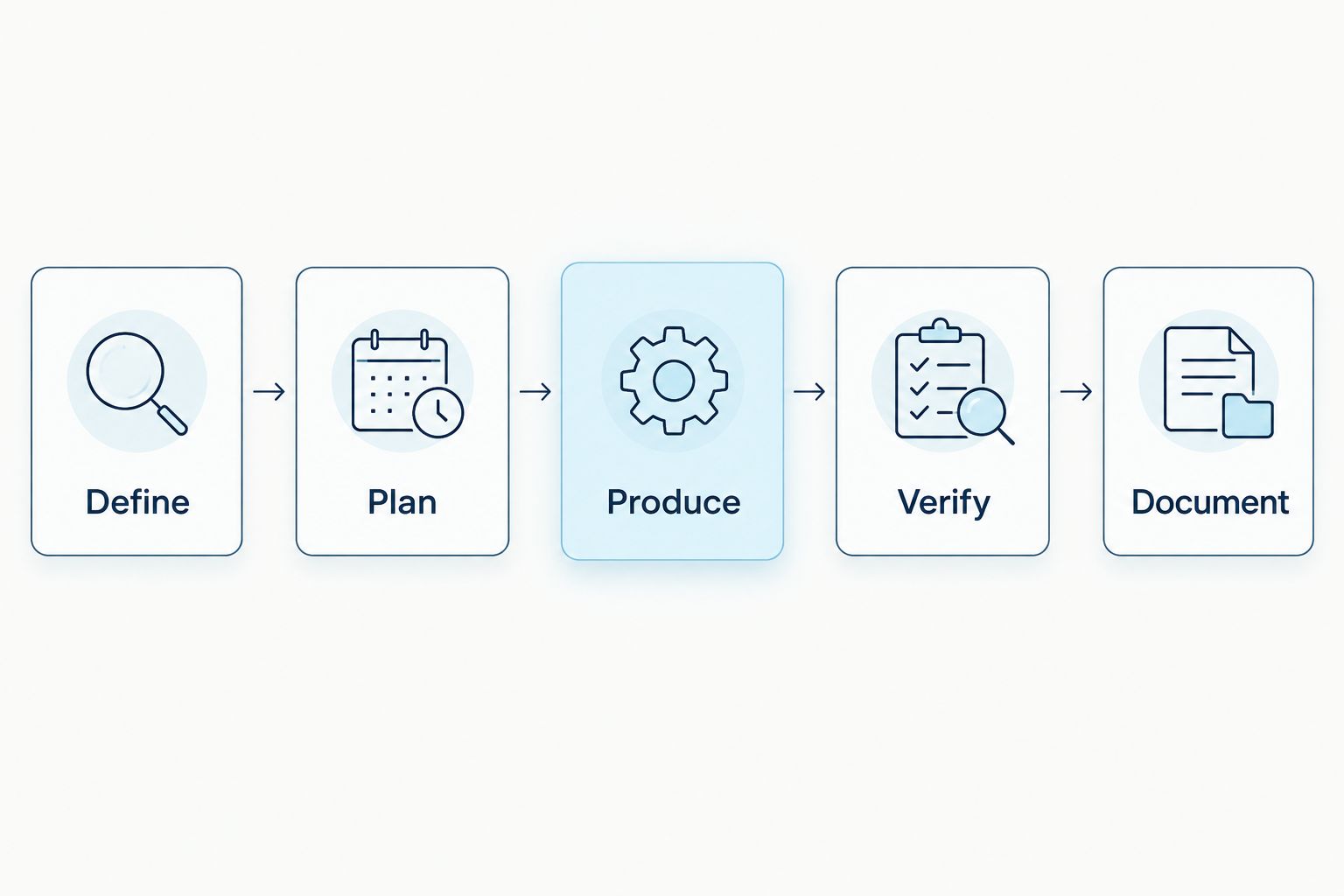
Evaluate a proposed project in this order:
- Define: Establish the target structure, required material form, research quantity, and acceptance criteria.
- Plan: Assess the route, difficult transformations, starting materials, and analytical checkpoints.
- Produce: Execute the agreed work and record deviations that affect subsequent stages.
- Verify: Characterize identity, purity, and other specified attributes using suitable methods.
- Document: Connect the delivered material to its lot record, analytical evidence, and approved scope.
Your custom synthesis specifications workflow should connect these decisions to the research requirement. Procurement approval alone does not resolve a chemical feasibility question.
A defensible scope identifies what is established, what requires experimentation, and what evidence permits progression. That distinction separates a defined synthesis assignment from an open-ended route-development project.
Why this matters for research procurement
A difficult synthesis can fail at isolation or characterization even when a reaction produces the intended species. A reaction mixture containing the target is not equivalent to delivered material that meets an agreed specification.
For 2026 procurement decisions, separate the scientific requirement from the purchasing description. A compound name and requested quantity do not define stereochemistry, salt form, impurity limits, or the records your laboratory needs.
Simple Life Science is best matched to qualified laboratory researchers and institutional buyers seeking research-only custom synthesis and analytical services. Evaluate any proposed project against its written scope rather than treating that service category as proof that a particular structure is feasible.
Define: specify the molecule and the deliverable
Start with an unambiguous structure. Include stereochemistry, substitution positions, relevant tautomeric or ionic form, and any deliberate isotopic labeling. A name alone is insufficient when it can describe different structural forms.
Define the delivered material separately from the molecular drawing. The requested free form, salt, or other specified form affects what must be prepared and characterized. Keep the requested research quantity distinct from the quantity of starting material used during development.
Your scientific brief should identify:
- The target structure and an editable structure file where available.
- The required stereochemical composition and how it will be assessed.
- The requested material form and research quantity.
- Identity and purity acceptance criteria, with the reporting basis stated.
- Required analytical data, lot identifiers, and handling documentation.
- Whether the assignment includes route development, synthesis execution, or both.
For a 2026 specification, identify the approved document version and the authority for changes. A revised target or acceptance criterion changes the assignment; it should not remain an informal email clarification.
Approve the specification before approving production. Otherwise, a supplier can prepare the named compound while your laboratory still lacks the material form or analytical evidence needed for its experiment.
Plan: choose a route against the actual constraints
Retrosynthetic planning works backward from the target to suitable precursors. A useful route proposal also explains the forward sequence: reaction compatibility, intermediate handling, purification, and the point at which difficult attributes will be assessed.
Linear and convergent routes are planning options, not competing service tiers. Neither is universally preferable.
| Route option | Best for | Principal advantage | Principal limitation | Evidence to request |
|---|---|---|---|---|
| Linear synthesis | Targets with a practical sequential route | A direct progression through successive intermediates | Material losses accumulate across the sequence | Intermediate isolation plan and support for difficult transformations |
| Convergent synthesis | Targets that permit separate fragment preparation | Fragments can be prepared independently before assembly | The joining reaction and fragment compatibility can become bottlenecks | Fragment specifications and evidence supporting final assembly |
| Route development | Targets without an adequately supported preparation | Tests uncertain chemistry before committing to a full sequence | Experimental work does not guarantee a successful route | Defined feasibility questions and progression criteria |
For route development, ask which uncertainty the first experiment resolves. Testing a key bond-forming transformation is different from preparing the complete target, and the deliverables should reflect that distinction.
A published route is supporting evidence, not automatic confirmation. Differences in substitution, stereochemistry, starting-material quality, or required scale can change the work needed to obtain an acceptable product.
Choose the route by its critical transformations and isolation burden, not by the shortest drawn sequence. A shorter route with an unresolved final separation is not automatically the stronger plan.
Produce: control intermediates and changes
Multi-step synthesis depends on intermediate suitability. An impurity introduced early can persist, react in a later transformation, or complicate final purification. Decide which intermediates require isolation and characterization before they enter subsequent reactions.
Not every intermediate needs the same review. The control strategy should follow the chemistry and written scope rather than impose identical testing on every stage.
Useful intermediate checkpoints address:
- Whether the intended transformation occurred.
- Whether the material is suitable for the next reaction.
- Whether a relevant stereochemical attribute has been preserved or established.
- Whether residual reagents or other impurities threaten downstream work.
- Whether the next stage can proceed under the approved plan.
Record changes to reagents, reaction conditions, purification, and material form when they affect the assignment. A substitution that solves a reaction problem can also change the impurity profile or analytical requirements.
Separate observations from conclusions. Detecting a signal consistent with an intermediate does not, by itself, establish isolated identity or purity.
Make progression criteria explicit. If an intermediate fails its agreed checkpoint, the next decision is investigation, reprocessing where appropriate, or route revision—not automatic continuation through the remaining sequence.
Verify: match each claim to an analytical method
Analytical characterization should answer the specification's questions. Chromatographic purity, molecular identity, stereochemical composition, and residual impurities are different attributes; one reported measurement does not establish all of them.
High-performance liquid chromatography can assess a chromatographic profile under a defined method. Its reported area percentage depends on separation and detection, and it does not automatically represent mass fraction or account for every impurity.
Mass spectrometry provides evidence about detected ions and molecular mass. Nuclear magnetic resonance provides structural information. Neither should be treated as a substitute for the complete analytical assessment required by the target and written scope.
| Analytical option | Best for | What it contributes | What it does not establish alone |
|---|---|---|---|
| HPLC | Assessing components resolved and detected by the method | Chromatographic profile and method-specific purity reporting | Complete identity or all undetected impurities |
| Mass spectrometry | Evaluating mass-related identity evidence | Information about detected ions consistent with the target | Full structural or stereochemical assignment |
| NMR spectroscopy | Evaluating molecular structure | Evidence supporting connectivity and structural assignment | Every trace impurity or every stereochemical requirement |
| Chiral chromatography | Assessing enantiomeric composition where separation is suitable | A stereochemical profile under the specified method | Complete identity and general impurity characterization |
Select additional analyses when the specification requires them. Water, residual solvents, elemental impurities, or counterion content need suitable assessment rather than an assumption based on an unrelated purity result.
Accept a purity statement only with its method and reporting basis. The meaning of the result depends on how the sample was prepared, separated, detected, and evaluated.
Document: connect the material to the evidence
The final documentation package should let your laboratory identify what arrived, which specification governed it, and which analytical evidence supports acceptance. A certificate of analysis is useful only when its contents can be connected to the delivered lot.
For a 2026 project record, request the approved specification version, lot identifier, analytical methods, reported findings, and disposition against acceptance criteria. Include the supporting data required by your institution rather than assuming that a summary certificate satisfies every review requirement.
The documentation review should distinguish:
- Measured attributes from attributes not assessed.
- Reported results from specification limits.
- Final-material records from intermediate-development observations.
- Approved changes from unresolved deviations.
- Supplier documentation from your laboratory's acceptance decision.
Simple Life Science offers custom synthesis and analytical services; define the requested documentation package within the project scope. Do not infer a specific test panel, reporting format, or deliverable from the service description alone.
A controlled project follows the same sequence from the initial brief through acceptance: Define, Plan, Produce, Verify, Document. Each stage should leave a record that supports the next decision.
Keep rejected versions and approved revisions distinguishable. Traceability breaks when the final material is assessed against a specification that changed without a corresponding record.
Why multi-step synthesis difficulty varies
Complexity depends on the chemistry and the required deliverable. These factors explain why apparently similar targets can require different development work:
- Chemoselectivity: Competing reactive groups can require selective conditions or protection, adding transformations and isolation work.
- Stereochemistry: Establishing or preserving the required configuration adds control requirements that general purity testing does not resolve.
- Intermediate stability: Decomposition or sensitivity can constrain isolation, storage, and the sequence of operations.
- Purification: Closely related impurities can make separation difficult even after the intended reaction succeeds.
- Scale: Mixing, heat transfer, and isolation behavior must be assessed when moving beyond the demonstrated preparation.
- Analytical suitability: Acceptance depends on methods that distinguish the required attributes and relevant impurities.
Ask for the project's dominant uncertainty. A route limited by stereochemical separation needs a different feasibility review from one limited by unstable intermediates.
Does a longer route mean the project is less feasible?
A longer route is not automatically less feasible. Step count describes sequence length; it does not establish reaction reliability, selectivity, intermediate stability, or ease of purification.
Compare the difficult transformations and acceptance requirements. A supported longer route can be more defensible than a shorter route with unresolved chemistry.
Can a compound be pure but incorrectly identified?
Yes—a chromatographically clean sample can still be the wrong compound. Purity and identity are separate questions, so the analytical package must address both against the target specification.
Require structural evidence appropriate to the molecule. Do not accept a purity percentage as a complete identity assessment.
Can a research synthesis route be transferred to a larger scale?
A research synthesis route requires scale-specific review before transfer. Reaction behavior, heat management, mixing, and isolation can differ from the demonstrated preparation.
Define the new scale and deliverable first. Then assess which transformations and controls need additional work rather than assuming direct transfer.
FAQ
Can complex small molecule services handle an unfamiliar target structure?
Complex small molecule services can assess an unfamiliar target through route and feasibility review. A proposed synthesis remains distinct from demonstrated preparation, so define the unresolved chemistry and progression criteria before authorizing the full assignment.
What should I send with a custom small-molecule synthesis request?
Send the target structure, stereochemistry, material form, requested research quantity, acceptance criteria, and documentation requirements. State whether you need route development, execution of an existing route, or both.
Is convergent synthesis better than linear synthesis?
Convergent synthesis is not universally better than linear synthesis. Compare fragment preparation, joining chemistry, intermediate isolation, and the final analytical requirements against the target structure.
Does high HPLC purity prove the correct molecule was synthesized?
High HPLC purity does not prove the correct molecule was synthesized. Identity requires appropriate supporting characterization, and chromatographic purity must be interpreted under its stated method.
Do multi-step synthesis projects need intermediate testing?
Multi-step synthesis projects need intermediate controls appropriate to the route and written scope. Define checkpoints where identity, impurities, or stereochemistry affect whether subsequent work can proceed.
What does Simple Life Science offer for laboratory synthesis projects?
Simple Life Science offers custom peptide and small-molecule synthesis and analytical services to qualified laboratory researchers and institutional buyers. Define the target-specific work and documentation requirements in the project brief.
What should procurement verify before accepting the final material?
Procurement should verify that the delivered lot, approved specification, and analytical documentation agree. The laboratory should assess reported findings against the acceptance criteria rather than relying on a certificate title alone.
One last thing
Write the acceptance decision before synthesis begins. If your team cannot describe the evidence required to accept the final material, the project specification is incomplete—even when the target structure is clear.
For your 2026 project brief, identify who reviews the analytical package and who approves deviations. That decision prevents a technically documented delivery from reaching procurement without a defined laboratory acceptance process.
Related guides
- Quality documentation for audit-ready QC records
- Certificates of analysis for ELN-ready records
- Combining small-molecule synthesis with peptide synthesis
- Small-molecule synthesis companies for research labs
For laboratory research use only. Not for human or veterinary use. Not intended to diagnose, treat, cure, or prevent any disease.

