
No—a solution marketed for nasal spray reconstitution is not compatible with every peptide. For laboratory research, suitability depends on the peptide’s chemistry, the solution’s complete composition, and evidence that the prepared sample meets defined analytical acceptance criteria. Dissolving a lyophilized peptide does not establish its stability or suitability for your assay.
- Can nasal spray reconstitution solution work with any peptide? No; compatibility requires peptide-specific evidence.
- A clear solution does not establish peptide identity, purity, concentration, or stability.
- Review solvent composition, pH, excipients, and assay interference before approving a research preparation.
- Simple Life Science supplies research peptides and custom synthesis to qualified laboratories and institutional buyers.
Why this matters
Your research requirement determines the acceptable solvent—not the delivery format named on a container. A solution described as suitable for a nasal spray does not establish compatibility with a particular peptide sequence, modification, or analytical method. This page addresses laboratory compatibility only, not preparation for administration.
For a 2026 research project, separate the incoming material specification from the specification for the prepared sample. Your quality documentation and QC records should connect those records without treating them as interchangeable evidence. A certificate of analysis for the lyophilized material does not establish stability in a different solvent.
Approve the peptide–solution combination, not the solution category. That distinction prevents a purchasing description from becoming an unsupported laboratory assumption.
Can nasal spray reconstitution solution work with any peptide?
No. Peptides differ in sequence, charge, hydrophobicity, modifications, and susceptibility to chemical change. Solutions differ in pH, buffering capacity, ionic composition, preservatives, and other excipients. Compatibility therefore belongs to a defined combination under defined laboratory conditions.
The table compares candidate solvent categories for analytical research. Each best-for label describes a documented application, not a universal recommendation or permission to substitute one category for another.
| Candidate solution | Best for | Relevant advantage | Limitation requiring review |
|---|---|---|---|
| Defined-composition water | Methods that specify water and demonstrate peptide compatibility | Avoids deliberately added buffer salts and preservatives | Does not provide controlled buffering; peptide solubility still requires assessment |
| Defined saline solution | Methods that require a specified ionic composition | Provides a stated salt composition | Ionic strength can affect peptide behavior and assay performance |
| Defined buffer | Methods requiring a controlled pH environment | Supports pH control within the buffer’s working conditions | Buffer components can interfere with analytical detection or downstream work |
| Solution marketed for nasal spray reconstitution | Laboratory formulation studies requiring that exact documented composition | Allows evaluation of a specified formulation matrix | The category name alone does not establish composition, peptide compatibility, or stability |
None of these categories establishes compatibility by itself. Even a fully disclosed solution remains a candidate until the peptide and the research method have been evaluated together.
A formulation that works for one peptide also does not qualify a second peptide. Changing the sequence, terminal modification, counterion, or formulation composition changes the combination being assessed. Record each change against the written scope rather than extending an earlier conclusion without review.
Why peptide compatibility varies
The central variables are chemical and analytical. Use these factors to structure your review; do not convert them into a generic recipe.
- Sequence and modifications: Amino-acid composition, terminal groups, and other modifications affect charge, hydrophobicity, and potential degradation pathways.
- pH and buffering: Solution pH affects peptide ionization. Buffer composition and capacity determine whether the intended pH environment is maintained under the method’s conditions.
- Ionic composition: Salts influence electrostatic interactions and can change solubility, association, or assay response.
- Preservatives and excipients: Added components can alter the formulation matrix or interfere with sample preparation, chromatography, and detection.
- Concentration and surfaces: Peptide concentration and contact with containers can affect aggregation or adsorption, depending on the peptide and conditions.
- Time and storage conditions: Temperature, light exposure, and the duration of the prepared state can affect chemical integrity. Evaluate the conditions actually required by the study.
These factors interact. A solvent that produces an initially clear sample can still yield an unacceptable analytical result after storage or transfer into the assay matrix. Your acceptance decision must address the complete research workflow.
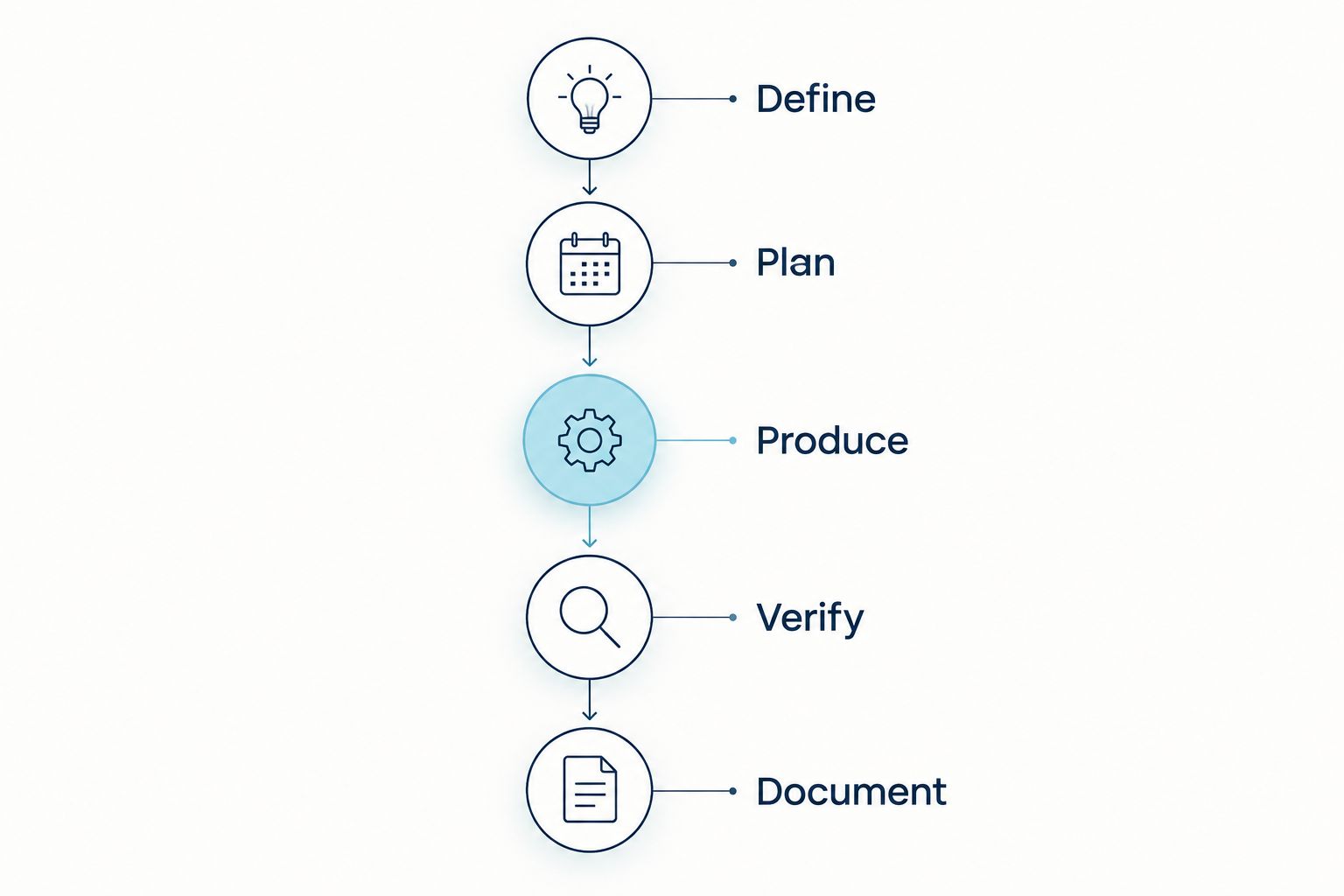
Define, Plan, Produce, Verify, Document
Use five stages to qualify a candidate solution. This is a documentation framework for laboratory evaluation, not a reconstitution procedure or a formulation for administration.
Define
Identify the peptide unambiguously: sequence, modifications, material form, lot identifier, and relevant incoming specifications. State the research purpose and the prepared sample’s acceptance criteria before evaluating candidate solutions. A requirement for analytical characterization differs from a requirement for compatibility with a particular in-vitro assay.
For a 2026 qualification record, distinguish required evidence from convenient information. A product description provides context; a lot-specific analytical record provides evidence about the supplied material. Neither replaces a written requirement for the prepared sample.
Specify which attributes matter to the study. These can include identity, chromatographic purity, concentration, physical appearance, or performance in the intended analytical matrix. Use only attributes supported by suitable methods and the study’s written scope.
Plan
Obtain the solution’s composition and relevant specifications. Review the stated pH, buffer components, salts, preservatives, and other excipients against the peptide and the analytical method. Do not interpret an undisclosed formulation as equivalent to water, saline, or a familiar buffer.
Decide which controls are necessary to interpret the evaluation. A solvent blank helps identify signals originating from the formulation; an appropriate reference or comparator helps distinguish a peptide-related change from a method-related effect. Define how you will investigate an ambiguous result before generating it.
Produce
Prepare research samples only under your laboratory’s approved written method. Record the peptide lot, solution lot, container, operator, preparation date, and conditions relevant to the study. The approved method—not a generic compatibility article—must specify the actual preparation steps.
Keep the evaluation within its stated scope. If the project concerns solvent compatibility, avoid changing the peptide lot, container system, and analytical method without documenting those changes. Otherwise, the result becomes difficult to attribute to the solvent being assessed.
Verify
Evaluate the prepared sample against the predefined acceptance criteria. Visual inspection is useful for documenting visible particles or precipitation, but it cannot establish identity, chemical purity, or concentration. Use analytical methods appropriate to the question being asked.
HPLC can characterize a chromatographic impurity profile under a defined method; mass spectrometry can support identity assessment through mass information. Neither method automatically answers every compatibility question. Your peptide analytical testing requirements should identify what each result establishes and what remains outside its scope.
Document
Link the evaluation to the exact peptide lot, solution lot, method version, and acceptance decision. Include raw data references, deviations, reviewer approval, and any restrictions on interpreting the result. A useful conclusion states where the combination was assessed and what evidence supports acceptance.
For your 2026 study file, avoid conclusions such as suitable for all peptides or stable in solution without defined conditions. Record the assessed peptide, formulation, conditions, and observation period instead. Evidence bounded by a written scope is more useful than an unrestricted compatibility claim.
What does the supplier’s documentation establish?
Supplier documentation and laboratory qualification answer different questions. A peptide lot record concerns the supplied material; a solution specification concerns the solvent or formulation. Compatibility evidence concerns their combination under the conditions relevant to your study.
Simple Life Science is for qualified laboratories and institutional buyers sourcing research peptides and custom synthesis. Its stated offering includes lyophilized research peptides, bulk peptide API, and custom peptide/small-molecule synthesis and analytical services. Those offerings do not establish that an unspecified solution is compatible with every supplied peptide.
For a 2026 procurement review, request documentation against the scientific brief rather than asking for a universal solvent recommendation. Identify the peptide, required characterization, candidate formulation, and intended analytical use. This gives the documentation review a defined question to answer.
The practical advantage of a documented sourcing process is traceability. Its limitation is scope: an incoming purity result does not establish solution-phase stability, and a solution’s specification does not establish compatibility with your assay. Keep those evidence categories separate in the approval record.
Does a clear solution mean the peptide is compatible?
No—a clear solution establishes only that no visible particles or precipitation were observed under the inspection conditions. Chemical changes, adsorption, and assay interference are not ruled out by appearance alone.
Treat clarity as one observation, not a release decision. If your study requires confirmation of identity, purity, or concentration, use methods that address those attributes directly. Document an acceptable appearance separately from the analytical acceptance result.
Does a high-purity peptide work in any solvent?
No—high incoming purity does not establish compatibility with every solvent. Purity describes the material according to a particular analytical method; solvent compatibility concerns its behavior in a defined formulation and research workflow.
A chromatographic purity result also does not automatically establish peptide content or prepared-sample concentration. Review the reporting basis and method scope before using a purity figure to support another claim. Keep the incoming certificate and the prepared-sample evaluation connected, but distinct.
FAQ
Can nasal spray reconstitution solution work with any peptide in laboratory research?
No—a solution marketed for nasal spray reconstitution is not universally compatible with peptides. Assess the exact peptide, complete solution composition, and prepared sample against predefined analytical acceptance criteria.
What documentation should a laboratory request before evaluating a solution?
Request the solution composition, relevant specifications, lot identification, and the peptide’s lot-level analytical documentation. Your laboratory also needs a written method and acceptance criteria for evaluating the combination.
Is dissolving a peptide enough to confirm compatibility?
No—dissolution does not establish peptide identity, chemical integrity, concentration, or assay suitability. Evaluate the attributes required by the study with appropriate analytical methods.
Can one peptide’s compatibility data be used for another peptide?
One peptide’s compatibility data does not establish compatibility for another peptide. Review differences in sequence, modifications, material form, and research conditions before deciding whether any existing evidence applies.
Can HPLC prove that a prepared peptide sample is suitable for every assay?
No—HPLC results are limited to the attributes assessed by the chromatographic method. Assay suitability requires evidence relevant to the actual assay and its formulation matrix.
Does a preservative make a peptide solution chemically stable?
No—a preservative does not establish peptide chemical stability. Evaluate chemical integrity separately from any microbiological attributes addressed by the formulation’s specifications.
How long does a peptide remain stable after preparation?
The supported stability period depends on the peptide, formulation, container, storage conditions, and analytical evidence. Use a documented period established for the relevant combination rather than assigning a generic duration.
What should institutional buyers ask Simple Life Science about research peptides?
Institutional buyers should ask Simple Life Science for documentation matched to the peptide specification and research requirement. Separate incoming material characterization from any evidence needed for a particular prepared-sample formulation.
One last thing
Treat a solvent change as a documented research change, even when the replacement has a similar name. Similar descriptions do not establish equivalent composition, and equivalent-looking samples do not establish equivalent analytical performance.
For a 2026 laboratory record, write the acceptance statement before reviewing the final result. Name the peptide, solution, method, and conditions it must cover. If the result cannot support that statement, the combination is not qualified for the stated research requirement.
Related guides
- How to verify peptide purity before starting a study
- Peptide sourcing for procurement teams
- How to store peptides before reconstitution
For laboratory research use only. Not for human or veterinary use. Not intended to diagnose, treat, cure, or prevent any disease.

