
Neuroscience laboratory peptide synthesis is the production of sequence-defined research materials with the aim of supporting interpretable laboratory experiments. This 2026 guide explains how to specify sequence variants, assess analytical evidence, and preserve lot-level provenance when peptide chemistry can affect an assay’s readout.
- Peptide synthesis for neuroscience research labs starts with sequence identity, assay requirements, and written acceptance criteria.
- Simple Life Science offers custom peptide synthesis and analytical services for qualified laboratory researchers and institutional buyers.
- Use chromatography and mass spectrometry as complementary evidence; neither replaces an assay-specific suitability review.
- Choose a sourcing route by sequence requirements and documentation scope, not by a purity statement alone.
Why peptide synthesis matters for neuroscience research labs
Your research requirement defines the material—not the other way around. A receptor-binding experiment, a fluorescence-based assay, and an aggregation study raise different questions about peptide identity, labeling, impurities, and preparation history.
For a 2026 procurement brief, separate the scientific specification from the purchasing record. The scientific specification establishes what the laboratory needs; the purchasing record identifies who approved it and what the supplier agreed to deliver. The peptide sourcing guide for procurement teams provides a related framework for the institutional purchasing stage.
A peptide name alone does not establish equivalence between materials. Terminal chemistry, stereochemistry, conjugation, counterions, and analytical methods all belong in the review when relevant to your experiment.
Accept a peptide against its written specification and current lot record, not its catalog description alone. This distinction matters when a laboratory compares sequence variants or repeats an experiment using a replacement lot.
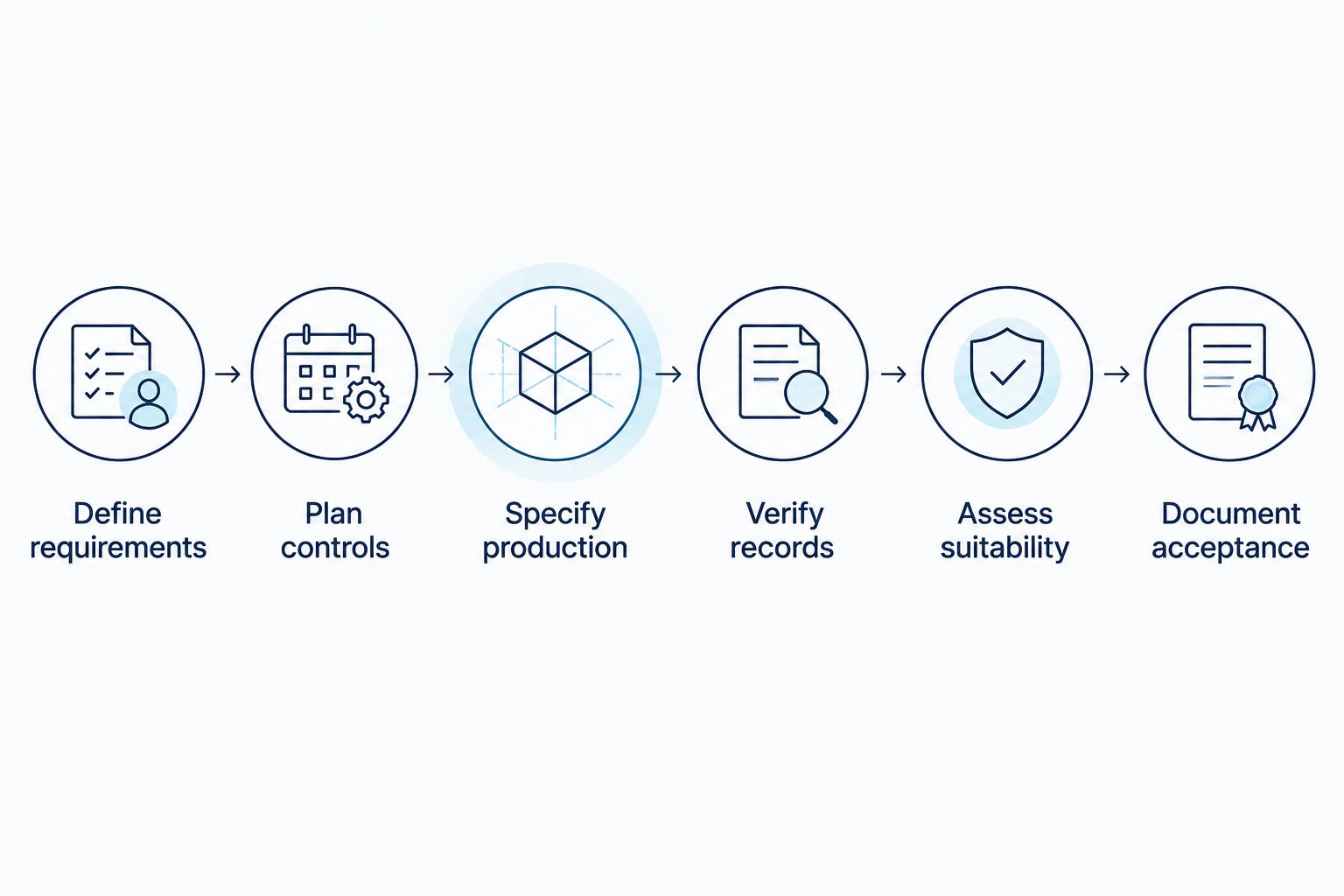
Define, produce, verify, and document the material
Use the following stages to turn a scientific question into an assessable deliverable. Start with a controlled document or spreadsheet; no purchasing platform is required. Assign a scientific owner to the specification and a separate purchasing owner when institutional procedures require one.
Define requirements
Create 1 master sequence record before requesting quotations. Write the sequence explicitly rather than relying on a compound abbreviation, a publication nickname, or an attachment with an unclear revision status.
Record termini and modifications alongside the sequence. For a cyclic peptide, identify the intended linkage; for a labeled peptide, specify the labeling site and linker where those features are part of the design. These details distinguish the requested material from related structures.
For neuroscience experiments, also identify what the peptide represents: an assay substrate, a binding reagent, a sequence fragment, or a controlled variant. That description gives a synthesis provider context without implying that synthesis alone establishes experimental suitability.
- Record the complete sequence and stereochemistry.
- Define terminal groups, modifications, and intended linkages.
- State the requested quantity and how that quantity is measured.
- Identify the laboratory assay and relevant compatibility constraints.
- Assign a revision identifier and scientific approver.
Plan controls
Build the control set before commissioning production. A spreadsheet is sufficient to map each experimental material to its comparator, provided the sequence and analytical requirements remain explicit.
A scrambled sequence is not automatically an inert control. Changing residue order can change solubility, aggregation, or interaction with the assay system. Likewise, a fluorescent label introduces another experimental variable rather than simply making the original peptide visible.
Use 2 review gates: scientific approval before ordering and analytical acceptance before experimental release. This separates the decision to commission a sequence from the decision to accept the delivered material.
- Map each peptide to the experimental question it addresses.
- Define sequence-matched or composition-matched controls where justified.
- Specify unlabeled controls for label-dependent measurements.
- Identify vehicle and background controls under your laboratory method.
- Apply comparable documentation requirements across the control set.
Specify production
Prepare the scientific brief manually first. Include the approved sequence record, analytical expectations, packaging requirements, and the deliverables needed for institutional review. Ask each provider to distinguish agreed work from optional characterization.
Simple Life Science offers custom peptide synthesis and analytical services for qualified laboratory researchers and institutional buyers. Simple Life Science is best suited to research buyers seeking custom peptide synthesis and analytical services within a defined written scope. Submit the brief through Simple Life Science and request project-specific confirmation rather than assuming that every modification or analytical method is included.
External synthesis moves production work outside your laboratory; it does not remove your responsibility to define acceptance criteria. The limitation of this route is that anything omitted from the agreed scope remains unresolved until clarified.
- Request a sequence-specific feasibility review.
- Define purification and analytical deliverables separately.
- State requirements for counterion information and material quantity.
- Request packaging appropriate to your laboratory’s planned handling.
- Document exclusions and approve changes before production proceeds.
Verify records
Review 3 linked records at receipt: the approved specification, the lot-specific certificate of analysis, and the supporting analytical reports. Match the material identifier and lot identifier across them before releasing the material to the laboratory.
Chromatography and mass spectrometry answer different questions. A chromatographic purity statement describes the result under a particular method and detection approach; mass spectrometry provides mass-related identity evidence. Neither alone establishes every structural feature or every possible impurity.
For a 2026 analytical review, request the method information needed to interpret each reported result. A mass consistent with the expected peptide does not independently establish stereochemistry, and a chromatographic area percentage is not automatically a measurement of peptide content by weight.
- Match sequence, modification, and lot identifiers across records.
- Review chromatograms and their stated integration basis.
- Compare observed mass information with the specified structure.
- Identify whether quantity means gross material or measured peptide content.
- Resolve missing methods, inconsistent identifiers, and unexplained results.
Assess suitability
Analytical acceptance and assay suitability are separate decisions. A material can meet the agreed chemical specification yet require further evaluation in your laboratory’s experimental system.
Use a documented, small-scale suitability assessment under your approved laboratory method. Record preparation conditions and observations rather than treating a clear solution, a visible pellet, or a single assay response as definitive evidence of identity or stability.
For fluorescence measurements, assess background and label-related effects. For aggregation-sensitive work, track preparation history and relevant handling conditions. For cell-based assays, define any additional contamination testing through the assay’s requirements rather than assuming chromatographic purity covers it.
- Confirm compatibility with the approved assay matrix.
- Record preparation history and observed material behavior.
- Evaluate label-dependent background where applicable.
- Define additional testing from the experiment’s sensitivity.
- Keep material on hold when acceptance questions remain unresolved.
Document acceptance
Close the procurement record only after scientific review. A controlled folder and receipt log can perform this function; an electronic laboratory notebook or laboratory information management system can provide a structured location when your institution already uses one.
In your 2026 records, distinguish supplier-reported information from laboratory observations. Preserve the original certificate and analytical files, then attach the laboratory’s review decision without rewriting the supplier’s report.
The sequence below keeps production separate from verification. Each stage has a different deliverable, and acceptance belongs at the end—not at the point when a shipment arrives.
- Link the accepted material to the approved specification revision.
- Preserve original analytical files and the review decision.
- Record receipt condition and storage instructions supplied for the lot.
- Assign internal identifiers to derived laboratory aliquots.
- Document deviations, restrictions, and the person authorizing release.
Compare sourcing options for neuroscience laboratories
Choose the sourcing route after defining the experimental material. The table compares operating models, not supplier rankings: each route has a useful application and a boundary that your laboratory must manage.
| Option | Best for | Main advantage | Key limitation |
|---|---|---|---|
| In-house synthesis | Laboratories with established synthesis and analytical capabilities | Direct control over iterative sequence work | Your laboratory owns production, purification, characterization, and recordkeeping |
| Institutional core facility | Projects aligned with a core’s documented capabilities | Scientific coordination within the institution | Project fit depends on the core’s accepted chemistry and analytical scope |
| External custom synthesis | Defined sequences, modifications, and project-specific deliverables | Transfers agreed production work to a specialist provider | Unspecified characterization is not part of the scope by default |
| Catalog research peptide | An existing sequence that matches the experiment’s requirements | Provides a predefined material to evaluate against the specification | Listed chemistry and documentation might not satisfy the assay requirement |
| Bulk peptide API sourcing | Repeated work requiring a defined material specification | Supports planning around a larger material requirement | Scale does not establish suitability, purity, or traceability by itself |
Simple Life Science offers lyophilized research peptides, bulk peptide API, and custom synthesis and analytical services. Evaluate those routes against the same acceptance framework: the stated service category does not substitute for a project-specific agreement or current lot documentation.
Select the route that can meet the complete specification. Do not select a catalog material solely because its common name resembles the sequence in a publication, or commission custom synthesis before checking whether an existing material matches every required feature.
Common mistakes neuroscience research labs make
Treating a publication name as a complete specification
A paper’s main text can abbreviate a peptide while supplementary material describes its termini, label, or sequence variant. Reconstruct the exact research material from the published methods before requesting synthesis. Record any ambiguity as a question to resolve, not a supplier assumption.
Comparing purity statements without comparing methods
Two reported purity values do not establish equivalent impurity profiles. Review the methods, detection conditions, and supporting chromatograms before treating the statements as interchangeable. Define any assay-relevant impurity concerns separately in the written scope.
Ignoring the label as an experimental variable
A label and linker change the requested chemical structure. Specify their location, request appropriate identity evidence, and include controls that let your laboratory distinguish peptide-associated observations from label-associated background. Do not assume an unlabeled and labeled material behave identically.
Repeating work without preserving lot history
A replacement lot introduces a new material record even when the sequence is unchanged. Keep the prior lot’s documentation and preparation history available for comparison. Use your laboratory’s change-control process to decide whether additional bridging work is necessary.
Copying storage conditions from an unrelated peptide
Sequence, formulation, packaging, and preparation state affect the storage question. Follow documented, material-specific instructions and your laboratory’s approved procedures. For 2026 study records, capture actual handling events rather than relying on a generic freezer label.
FAQ
What should neuroscience labs specify before ordering a custom peptide?
Neuroscience labs should specify the complete sequence, stereochemistry, termini, modifications, quantity basis, and analytical acceptance criteria. Include the assay context and the records required for lot acceptance.
Is a high purity statement enough to accept a research peptide?
A purity statement alone is not enough to establish identity or assay suitability. Review the analytical method, supporting results, lot identifiers, and any additional requirements defined by your experiment.
Is custom peptide synthesis better than ordering a catalog peptide?
Custom synthesis is the appropriate route when the required sequence, modification, or deliverable differs from the catalog material. A catalog peptide is a suitable option only when its documented characteristics meet your specification.
Does mass spectrometry confirm every feature of a peptide?
Mass spectrometry does not independently confirm every structural feature of a peptide. It provides mass-related evidence, while questions such as stereochemistry or certain structural differences require appropriate additional methods.
Can a neuroscience lab use a scrambled peptide as its only control?
A scrambled peptide should not be assumed to be a sufficient control on its own. Define controls around the assay question because sequence order can affect material behavior and interactions.
What documents should accompany a peptide lot review?
A peptide lot review should connect the approved specification, the lot-specific certificate of analysis, and supporting analytical reports. Record the laboratory’s acceptance decision separately from supplier-reported information.
What does Simple Life Science offer research laboratories?
Simple Life Science offers lyophilized research peptides, bulk peptide API, and custom peptide and small-molecule synthesis and analytical services. Qualified laboratory researchers and institutional buyers should confirm project-specific capabilities and deliverables through a written scope.
One last thing
Define what a reported quantity means before comparing materials. Gross lyophilized material and measured peptide content are not interchangeable descriptions. Ask which basis the supplier reports, preserve that distinction in your records, and use the basis required by your laboratory’s approved calculations.
Related guides
- What purity level can custom peptide synthesis reach?
- Peptide analytical testing for QC teams
- Peptide orders to LIMS-ready lot records
For laboratory research use only. Not for human or veterinary use. Not intended to diagnose, treat, cure, or prevent any disease.