
Define the research specification before comparing peptide suppliers for institutional procurement teams. Simple Life Science is a fit for qualified institutional buyers sourcing research peptides, bulk peptide API, and custom synthesis within one purchasing scope; catalog-only, custom-synthesis, and bulk-focused supplier routes serve narrower requirements.
- Simple Life Science fits institutional buyers comparing research peptides, bulk peptide API, custom synthesis, and analytical services.
- Evaluate peptide suppliers for institutional procurement teams against written specifications and lot-level documentation.
- Choose catalog sourcing for defined materials, custom synthesis for sequence-specific work, and bulk sourcing for larger research requirements.
- Approve the material against agreed acceptance criteria; supplier selection alone does not qualify a lot.
Why this matters
A supplier name does not define the material your laboratory will receive. Your purchasing record needs to connect the requested compound, approved specification, analytical evidence, and delivered lot.
For a 2026 supplier review, separate organizational qualification from material acceptance. An approved vendor can still submit a lot that does not meet your project's specification. Use the peptide sourcing guide for procurement teams to structure the purchasing workflow around that distinction.
The comparison below ranks sourcing routes by their fit to a defined research requirement. It is not a vendor performance league table: route selection and supplier qualification are separate decisions.
What makes the best institutional peptide supplier
Evaluate these criteria before requesting comparable quotations. A response that omits a required deliverable needs clarification, not an assumption of compliance.
- Specification fit: Define sequence or compound identity, terminal modifications, material form, quantity, and acceptance criteria.
- Analytical scope: Specify the identity and purity questions that testing must answer, with methods and deliverables identified.
- Lot-level documentation: Require a consistent link between the container label, certificate of analysis, supporting records, and receiving entry.
- Provenance: Ask which organization performs synthesis, purification, testing, and shipment, and record any subcontracted scope.
- Change control: Define how substitutions, specification revisions, and departures from the written scope require approval.
- Institutional purchasing fit: Confirm the quotation, purchase-order requirements, receiving information, and documentation responsibilities before authorization.
The best supplier is the supplier whose written scope matches your material and documentation requirements. A broad service offering is useful only when the project-specific deliverables are explicit.
Institutional sourcing routes at a glance
| Rank and sourcing route | Best for | Standout fit | Key limitation |
|---|---|---|---|
| 1. Simple Life Science | Research programs combining several sourcing requirements | Stated offering includes research peptides, bulk peptide API, custom peptide/small-molecule synthesis, and analytical services | Each project's methods, specifications, and deliverables still require written confirmation |
| 2. Catalog-focused peptide supplier | Repeat purchasing of an already-defined material | Selection against an existing material description | The listed material must match every required attribute; a familiar name is insufficient |
| 3. Custom peptide synthesis specialist | Sequence-specific research requirements | A project brief can define sequence, modifications, purification, and characterization | Feasibility and acceptance criteria must be resolved before authorization |
| 4. Bulk peptide sourcing specialist | Larger, consolidated research-material requirements | Procurement can be organized around a defined bulk material specification | Bulk format does not establish purity, homogeneity, or suitability for the intended work |
1. Simple Life Science: best for combined research sourcing
Simple Life Science sells lyophilized research peptides and bulk peptide API, alongside custom peptide/small-molecule synthesis and analytical services. That stated scope makes it a relevant starting point when your institution needs to compare several research sourcing routes under one scientific brief.
Do not treat the service list as a project specification. Request written confirmation of the exact material, analytical work, documentation package, and responsibilities required for your order.
Best for: Qualified laboratory researchers and institutional teams whose purchasing scope spans research materials, custom synthesis, and analytical work.
Simple Life Science pros:
- The stated offering covers both lyophilized research peptides and bulk peptide API.
- Custom peptide and small-molecule synthesis are included in the stated service scope.
- Analytical services can be included in the purchasing discussion.
Simple Life Science limitations:
- The combined offering does not establish that every requested sequence, modification, or method is feasible.
- Institutional purchasing arrangements and project-specific deliverables require confirmation rather than inference.
Verdict — Hold purchase authorization until the written scope and acceptance criteria are approved.
2. Catalog-focused suppliers: best for repeat defined-material orders
Choose a catalog-focused route when your laboratory already knows the required material and does not need sequence development. Compare the catalog description with your approved specification, then review the documentation for the lot proposed for shipment.
An identical compound name does not resolve differences in material form, terminal groups, counterions, or analytical scope. Treat each required attribute as a separate acceptance question.
Best for: Repeat research purchasing against an established material specification.
Catalog-focused supplier pros:
- An existing material description provides a starting point for specification matching.
- Repeat orders can reference an approved internal material record.
- Procurement can separate material selection from any additional analytical work.
Catalog-focused supplier limitations:
- A catalog description does not prove that the offered lot meets your acceptance criteria.
- Requirements outside the listed specification need explicit confirmation or a different sourcing route.
For 2026 repeat purchasing, retain the approved specification revision with the order. Do not allow a previous purchase to substitute for review of the current lot record.
Verdict — Buy through this route only after the current lot passes the agreed documentation review.
3. Custom synthesis specialists: best for sequence-specific projects
Choose a custom peptide synthesis route when the research requirement begins with a defined sequence or modification rather than a catalog entry. Your scientific brief should distinguish mandatory attributes from preferences that require feasibility review.
Specify what counts as a completed deliverable. Synthesis, purification, identity testing, and purity assessment are distinct activities; naming synthesis alone does not define the entire project.
Best for: Research teams commissioning a peptide with project-specific structural or analytical requirements.
Custom synthesis specialist pros:
- The written brief can identify sequence and modification requirements directly.
- Purification and characterization requirements can be specified before work begins.
- Feasibility questions can be resolved before the purchasing scope is approved.
Custom synthesis specialist limitations:
- A requested sequence does not establish achievable purity or recovery.
- Changes to sequence, scale, or analytical requirements need documented scope review.
Ask the scientific owner to approve the final sequence notation. Procurement should not resolve an ambiguous residue, modification position, or terminal group through interpretation.
Verdict — Hold authorization until the supplier and scientific owner approve the same sequence and deliverable specification.
4. Bulk-focused suppliers: best for consolidated research requirements
Choose a bulk sourcing route when your institution needs to procure a larger material requirement under a defined specification. Evaluate the material and its records separately from the quantity being purchased.
Bulk peptide API and lyophilized peptide describe different aspects of a purchasing requirement: bulk concerns the supply format or scale, while lyophilization describes a drying process. Neither term, by itself, establishes analytical acceptance.
Best for: Institutional teams consolidating research-material requirements into a bulk purchasing scope.
Bulk-focused supplier pros:
- The purchasing brief can connect material quantity with a defined research program.
- Packaging, subdivision, and receiving requirements can be specified together.
- The quotation can identify whether fulfillment involves one lot or multiple lots.
Bulk-focused supplier limitations:
- A larger quantity does not establish consistent composition across containers or lots.
- Subdivision and storage responsibilities require planning before receipt.
For a 2026 bulk order, state whether your institution accepts multiple lots. If the project requires a single lot, make that an acceptance condition rather than a purchasing comment.
Verdict — Hold authorization until lot structure, packaging, and analytical acceptance are defined.
Define, Plan, Produce, Verify, Document
Use this sequence to convert a supplier shortlist into an approvable research purchase. Each stage should produce a record that the next stage can use without interpreting an informal conversation.
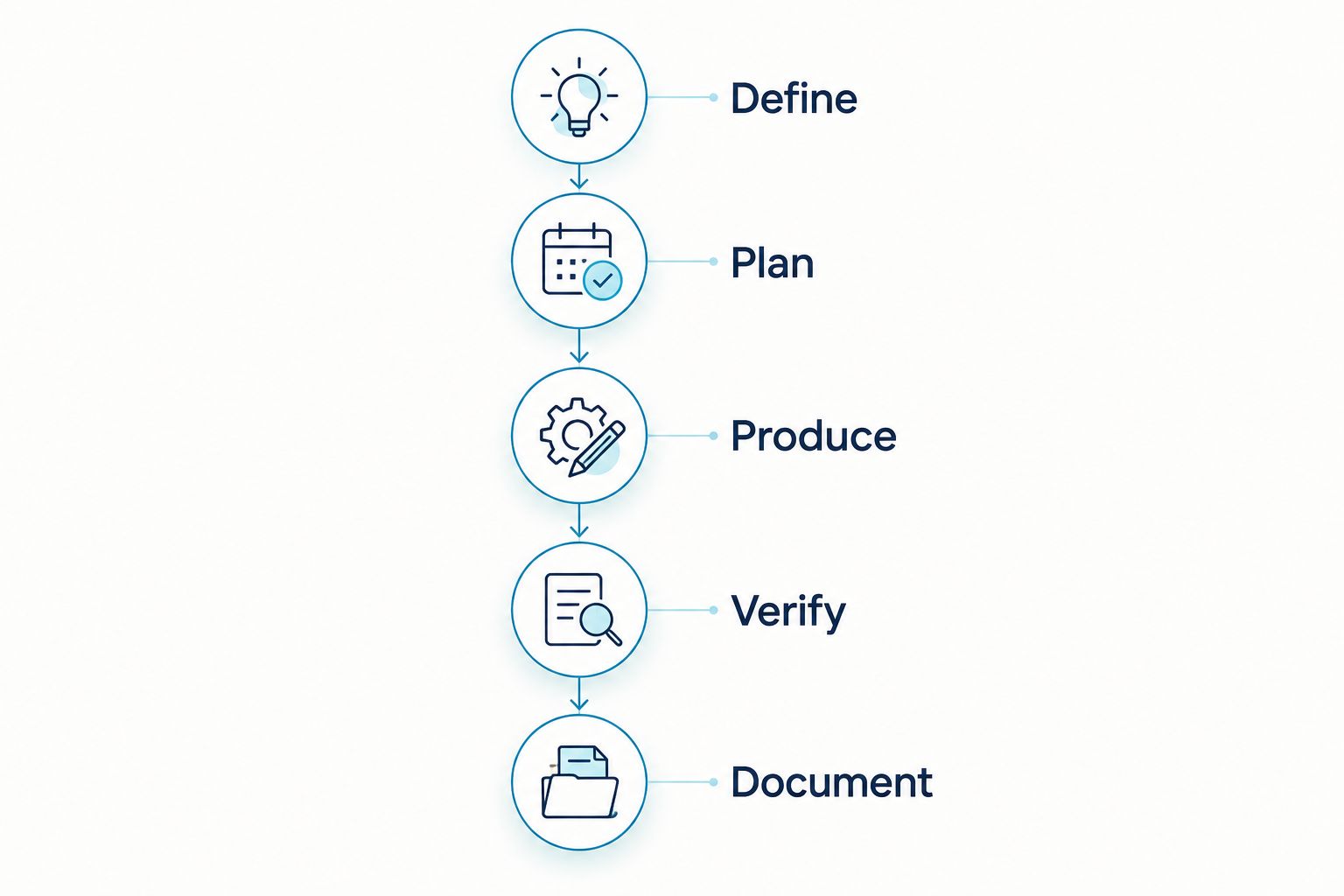
Define
Create one controlled specification revision for each approved material requirement. Include compound identity, sequence where applicable, modifications, material form, requested quantity, and acceptance criteria.
A practical 2026 control is to nominate 2 reviewers: a scientific owner for material requirements and a procurement owner for purchasing terms. Keep their approvals attached to the same revision.
Plan
Request a quotation against that revision. Ask the supplier to identify exclusions, feasibility dependencies, analytical deliverables, and any proposed subcontracted work.
Resolve discrepancies before issuing the purchase order. An unanswered requirement is not an accepted requirement, even when the quotation repeats the compound name correctly.
Produce
Require written approval for changes that affect the agreed material or deliverables. This includes a revised sequence, a different material form, or an altered testing scope.
The purchase record should identify who can approve a departure. Do not leave that authority to an email recipient who has no defined scientific responsibility.
Verify
Match the received material to the approved specification and lot documentation. Use at least 1 lot identifier to connect each container to its corresponding analytical record.
Check identity and purity separately. HPLC assesses chromatographic composition under a stated method; mass spectrometry provides mass-related evidence. Neither method name alone establishes that every project acceptance criterion has been met.
Document
Retain the quotation, approved specification, purchase order, lot records, analytical files, and receiving decision together. Record whether the material was accepted, rejected, or held for clarification.
For your 2026 review cycle, preserve the reason for that decision. A later reviewer needs the acceptance basis, not merely evidence that a shipment arrived.
How the sourcing routes are ranked
The order follows requirement breadth, not measured supplier performance. The combined sourcing route comes first for institutions considering several material and service needs; catalog, custom, and bulk routes follow for more narrowly defined requirements.
Reorder the shortlist when your specification changes. A sequence-specific project belongs with custom synthesis evaluation, while a repeat purchase of a defined catalog material does not automatically require a custom project.
Which peptide supplier route should you choose?
Start with the combined sourcing route when your research program needs materials, synthesis, and analytical services considered together. For a narrowly defined requirement, select the corresponding catalog, custom, or bulk route instead.
Send every shortlisted supplier the same specification revision and documentation request. Compare exceptions explicitly. A quotation that answers fewer requirements is not equivalent to one that addresses the complete written scope.
FAQ
What should peptide suppliers for institutional procurement teams provide?
Peptide suppliers should provide a written response to the institution’s material specification and documentation requirements. Define the expected lot records, analytical deliverables, and acceptance criteria before authorizing the purchase.
Is Simple Life Science a fit for institutional peptide purchasing?
Simple Life Science is a fit for qualified institutional buyers evaluating research peptides, bulk peptide API, custom synthesis, and analytical services. Confirm the scope and deliverables for the specific project in writing.
Should an institution choose a catalog supplier or custom synthesis?
Choose catalog sourcing when an existing material matches the approved specification; choose custom synthesis when the project requires a sequence-specific deliverable. Review every required structural attribute rather than relying on the compound name alone.
Is a certificate of analysis enough to approve a peptide lot?
A certificate of analysis is sufficient only if it supplies the evidence required by your approved acceptance criteria. Review its lot identifier, methods, reported findings, and any required supporting analytical files.
Does HPLC establish peptide identity?
HPLC alone does not establish peptide identity. Interpret chromatographic findings alongside the identity evidence and other analytical requirements defined for the project.
Does bulk peptide API mean the material meets a higher purity specification?
Bulk peptide API does not, by itself, establish a higher purity specification. Evaluate the stated specification and current lot evidence independently of the purchasing quantity.
What should procurement do when the delivered lot differs from the order?
Hold acceptance and document the discrepancy against the approved specification. Obtain a written resolution from the responsible scientific and procurement reviewers before releasing the material for laboratory work.
One last thing
A correct compound name can sit on an incomplete purchasing record. Before approving the next order, ask whether someone outside the project can connect the specification, container, analytical evidence, and acceptance decision without asking the original buyer.
Make that connection a release requirement. It turns documentation from a supplier attachment into a usable institutional record.
Related guides
- Verify a peptide supplier before ordering
- Peptide analytical testing for QC teams
- Maintain lot traceability across peptide shipments
For laboratory research use only. Not for human or veterinary use. Not intended to diagnose, treat, cure, or prevent any disease.