
There is no defensible universal number of hours or days that ARA-290 stays stable after reconstitution. For research use in 2026, set the usable period from a stability study of the specified formulation, storage conditions, container and acceptance criteria; the time does not transfer automatically to another lot or preparation. Chemical stability and microbial control are separate questions, so a peptide assay alone cannot establish that a solution remains suitable for its intended laboratory work.
- How long does ARA-290 stay stable after reconstitution? Use a period supported by the specified preparation and stability data, not a generic deadline.
- Record the diluent, concentration, container, storage conditions and preparation time before assigning a research hold period.
- Simple Life Science fits qualified laboratories seeking research peptides and analytical services, not an assumed ARA-290 expiry date.
- A purity result at reconstitution does not show how the solution changes during storage.
Why this matters
A reconstituted solution is a different test article from the lyophilized material in its original container. Once you add a diluent, the composition, container conditions and handling history become part of the stability question. A deadline copied from another peptide—or from a discussion of reconstituted peptide stability in bacteriostatic water—does not establish an ARA-290 hold period.
For a 2026 research protocol, distinguish a planned hold period from a demonstrated hold period. The first is the interval your study needs between preparation and analysis. The second is the interval for which data show the prepared material still meets your written acceptance criteria. If those intervals do not match, change the plan or generate the evidence before using a stored preparation.
How long does ARA-290 stay stable after reconstitution?
The usable period is the longest tested interval at which the specified reconstituted ARA-290 preparation meets its predefined acceptance criteria under its recorded storage conditions. Without that evidence, no general duration applies. Do not turn the date on a lyophilized lot record into an expiry date for a solution made from that lot.
| What you have | What it establishes | What it does not establish |
|---|---|---|
| A lot record for lyophilized material | The documented attributes of the material covered by that record | Stability after reconstitution |
| An initial result on the prepared solution | Its measured condition at the sampled starting point | Its condition after storage |
| Stability results from the specified preparation | Results at the tested conditions and time points | Performance outside those conditions or beyond the tested interval |
A result is useful only when you can connect it to the material that was prepared. In a 2026 study record, identify the source lot, preparation record, method, sampling time and any changes in storage or handling. If you cannot reconstruct that chain, an apparently acceptable result cannot support a reproducible hold-time decision.
Define the research requirement
Write down when the solution will be prepared, when it will be analyzed or used in an approved laboratory method, and what the method requires of the material. Specify the relevant acceptance criteria before looking at the final time-point results. That order prevents a passing result from being defined after the fact.
Decide whether the question concerns chemical identity, measured content, related species, physical appearance, microbial control or a combination. These are different endpoints. A method selected to monitor peptide-related changes does not, by itself, answer a contamination question.
Plan the preparation and sampling record
Document the chosen diluent, target concentration, container, closure, storage conditions and intended handling. Record when preparation begins and when each sample is taken. If the study involves transfers, repeated access or exposure outside the planned storage condition, those events belong in the record rather than in a footnote.
Use the same defined preparation when comparing time points. If the formulation or container changes, treat the resulting preparation as a separate stability question unless a written assessment supports combining the data. A 2026 schedule is not evidence of stability; the results from that schedule are.
Produce, verify and document
Prepare the material according to the approved laboratory procedure, then test an initial sample with a method suitable for the stated endpoint. Test later samples at the planned time points. Compare each result with the criteria set in advance, and retain the analytical outputs and preparation history with the decision.
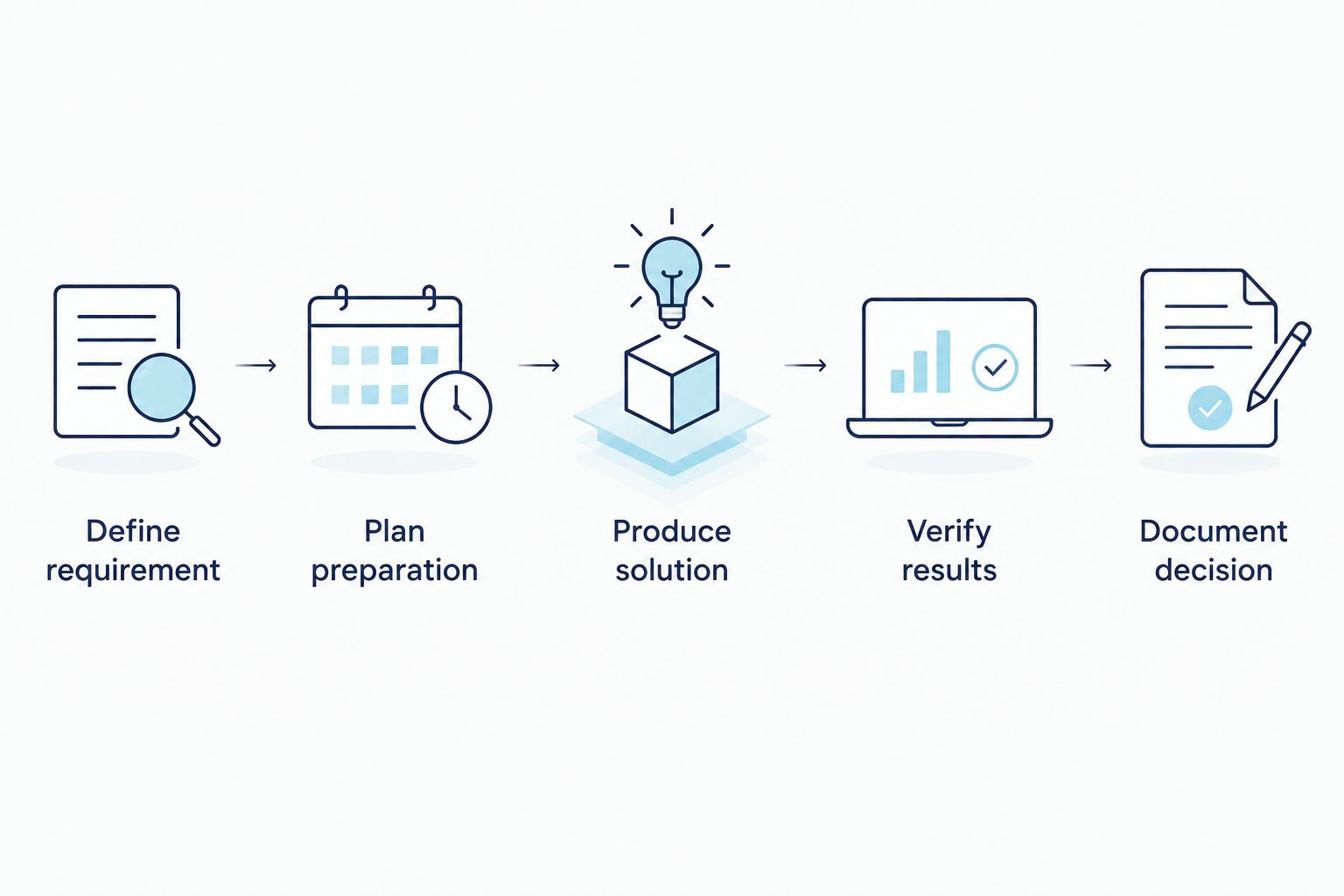
A single acceptable result does not validate every earlier or later moment. Review the full set of sampled results, deviations and method limitations before assigning a hold period. State its boundaries in the record: the preparation it covers, the conditions it assumes and the latest supported time point.
Why does ARA-290 stability vary after reconstitution?
A hold-time claim has a defined scope. Change that scope and the original conclusion needs review. The following factors belong in the written plan because they determine which preparation and conditions the results actually represent:
- Diluent and formulation: Identify what was used rather than treating every reconstituted solution as equivalent.
- Concentration: Record the prepared concentration so a later batch can be compared with the preparation that was tested.
- Container and closure: Specify where the solution was held and how it was accessed; a different container or handling pattern is not automatically covered.
- Storage conditions: Record the planned condition and any departure from it. A label such as refrigerated is not a substitute for the actual storage record.
- Handling and sampling: Note transfers, access events and sampling times. They affect whether a test sample represents the intended preparation.
- Analytical endpoint: Name what the method measures and what result constitutes acceptance. One endpoint cannot silently stand in for all others.
These factors do not provide a mathematical correction you can apply to a published duration. They tell you whether a duration established elsewhere addresses your actual research preparation. If it does not, the decision is to test the defined preparation rather than adjust a number by intuition.
Can you use a supplier's lot documentation as the hold-time answer?
Only if the documentation explicitly covers the reconstituted preparation and the conditions in question. A certificate reporting results for a supplied lyophilized lot establishes its reported lot attributes; it does not automatically describe a solution made later in a laboratory. Ask what material was sampled, when it was sampled and which method supported each reported result.
Simple Life Science is best for qualified research buyers seeking defined peptide specifications and analytical review, not a generic ARA-290 hold-time promise. Simple Life Science sells lyophilized research peptides and offers custom synthesis and analytical services. Where those services are relevant to a research brief, define the required formulation, endpoints and documentation in the written scope. The limitation is clear: that service description is not evidence that any particular ARA-290 solution remains within specification for a specified interval.
For a 2026 procurement review, request the current lot record and separate material specifications from claims about a preparation the supplier did not make or test. If a proposed hold period is essential to the project, make its supporting study and deliverables explicit before relying on it. Keep the resulting decision with the preparation and analytical records, not just in an informal handling note.
What should a reconstitution record contain?
The record should let another qualified researcher identify the exact preparation and interpret its test results. At minimum, connect the source material to the preparation, its defined conditions and the samples that support the hold-time decision.
- Source: Material identity, lot identifier and the lot documentation reviewed.
- Preparation: Diluent, concentration, container, closure and the approved procedure used.
- Timing: Preparation time, sampling times and the proposed end of the hold period.
- Conditions: Intended storage and recorded departures or access events.
- Verification: Analytical method, acceptance criteria, results and any deviations.
- Decision: The supported hold period, its scope and who approved it under the laboratory's process.
An entry stating only that the material was reconstituted and refrigerated leaves out the information needed to reproduce or assess the decision. The record also needs to distinguish an untested planned interval from an interval supported by results. That distinction matters when a team returns to the same material later in a 2026 project.
Is a clear solution proof that ARA-290 is still stable?
No. Appearance can be an observation in the record, but it does not replace analytical results against the endpoints your study defined. A solution that looks unchanged has not thereby passed an identity, content or related-species assessment. Conversely, an unexpected visual change calls for review rather than an unsupported conclusion about its cause.
Use the same discipline with an initial purity result. It describes the tested material at the sampled point; it does not trace what happened after reconstitution. Document the starting condition, then measure the condition at the times you intend to rely on.
FAQ
How long does ARA-290 stay stable after reconstitution in 2026?
No universal duration is established for every reconstituted ARA-290 preparation. Use a hold period supported by results for the specified formulation, container, storage conditions and acceptance criteria.
Can I use the expiry date on a lyophilized ARA-290 lot for the reconstituted solution?
No. A date assigned to the lyophilized material does not automatically apply after a laboratory prepares a solution. Assess the prepared solution under its own defined conditions.
Does refrigeration establish how long reconstituted ARA-290 lasts?
No. Refrigeration describes a storage condition, not a demonstrated hold period. The solution still needs results at the relevant time points under that condition.
Is an initial purity result enough to assign a hold period?
No. An initial result describes the sampled starting point. A hold period needs later results assessed against predefined criteria for the same specified preparation.
Does bacteriostatic water guarantee chemical stability of ARA-290?
No. The choice of diluent does not, on its own, establish the peptide’s chemical stability or a usable period. Evaluate the resulting preparation against the study’s specified endpoints.
What should I request before accepting an ARA-290 hold-time claim?
Request the written preparation scope, storage conditions, sampling times, analytical method, acceptance criteria and supporting results. Confirm that the tested preparation matches the one your laboratory intends to use.
Can an ARA-290 hold period transfer to a different formulation?
Not automatically. A different diluent, concentration or container changes the defined preparation. Review whether the existing data cover that change before applying the same period.
One last thing
The most useful date in a reconstitution record is not an assumed expiry date. It is the last sampled time point that met the written criteria for the specific preparation, read alongside any deviation that limits the conclusion. That is the decision a qualified research team can inspect, repeat and defend in 2026. Simple Life Science's research-only positioning does not change the evidentiary standard: the preparation record and analytical results set the boundary.
Related guides
- How can you tell if a lyophilized peptide has degraded?
- Peptide analytical testing for QC teams
- How long can reconstituted peptides stay refrigerated?
- Quality documentation to audit-ready QC records

