
Freezer inventory that can't be traced back to a certificate of analysis is not a lot record — it's a box of vials with a date on it. Instead of reconstructing chain-of-custody after an internal audit or a reviewer question, build peptide lot traceability into the order itself, so every vial that reaches -20°C storage already carries its lot number, its analytical reference, and its storage location as one linked record.
- Peptide lot traceability links each order to a certificate of analysis, a storage location, and a retest date in one continuous record.
- Freezer-ready traceability means the lot number and CoA reference are logged before the vial reaches the rack, not after.
- Simple Life Science ships lyophilized research peptides with lot-level documentation; the freezer-to-record link is built by the receiving lab.
- Incoming verification, not the freezer log, is where most traceability chains break in practice.
- Requalification and retest dates belong in the same record as the original CoA, not a separate spreadsheet.
Why This Matters
A lot record exists so a researcher can answer one question months later: what was in this vial, and what confirmed it. Without a defined field structure connecting the purchase order, the certificate of analysis, and the physical storage slot, that answer takes an afternoon of email searches instead of a lookup.
Institutional buyers and CROs increasingly require documented chain-of-custody before a peptide lot is approved for use in a study protocol. Building freezer-ready traceability into the intake process — rather than retrofitting it during an audit — is the difference between a workflow and a scramble.
This guide covers the intake-to-freezer path for research peptides sourced under a defined specification, plus the requalification variant for lots that sit in storage past their initial retest window.
Before You Start
- A defined specification and purchase order reference for each incoming lot — traceability starts at the PO, not the freezer.
- A place to store the certificate of analysis (CoA) tied to the lot number — a shared drive folder, a LIMS record, or a paper binder with a controlled index all work, as long as the lot number appears on both the CoA and the physical storage entry.
- The gotcha: if your freezer inventory sheet and your CoA archive use different lot identifiers — supplier lot number in one, an internal accession number in the other — you will not be able to trace a vial back to its documentation without a cross-reference field. Decide on one identifier system before the first vial goes into the rack, not after the third shipment arrives.
Define the Order and Custody Fields
Set the record structure before anything physical arrives.
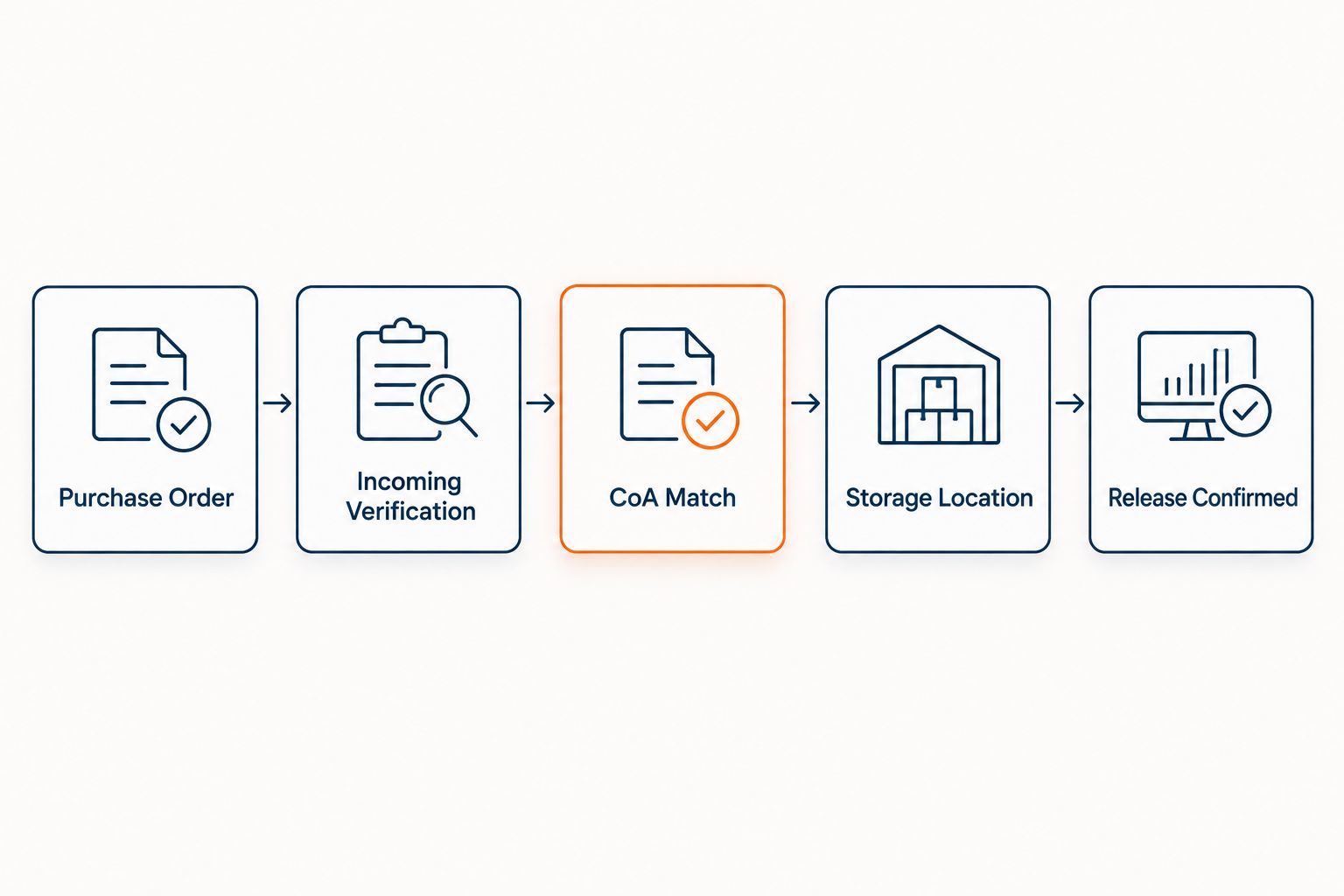
- Create a lot record template with, at minimum: Lot Number, Purchase Order Reference, Date Received, CoA Reference, Storage Location, and Retest Date.
- Assign one identifier — the supplier's lot number is the simplest choice — as the primary key across every downstream record. Do not introduce a second numbering scheme for internal use unless it maps back to the primary key in the same row.
- Log the purchase order and the expected lot count against the specification you ordered against, before the shipment is opened.
Expected result: an empty record exists for every incoming lot before the box is opened, with the lot number as the single field that ties everything else together.
Set Up Incoming Verification and Certificate Matching
This is the stage where most traceability gaps actually form, because it happens under time pressure at intake.
- On arrival, confirm the physical lot number on the vial or bulk container label matches the lot number on the shipping documentation and the CoA.
- Open the CoA and confirm it corresponds to the specific lot received — not a representative or prior-lot CoA. If the document doesn't cite the exact lot number, treat the shipment as unverified until a lot-specific CoA is provided.
- Attach or link the CoA file to the lot record created in the previous stage, using the lot number as the filename or the linking field.
- Mark Date Received and CoA Verified as complete only after both checks pass.
Expected result: every lot in the record system has a confirmed, lot-specific CoA attached before it is assigned a storage slot.
Configure Freezer Placement and Label Mapping
Physical storage location has to be a field in the record, not tribal knowledge about which shelf.
- Assign a Storage Location code — freezer unit, shelf, box position — and write it into the lot record.
- Label the physical container with the lot number and storage location code so the label and the record agree.
- If splitting a bulk lot across multiple containers or freezers, log each sub-location separately against the same parent lot number, so a partial-lot search still resolves.
Expected result: given only a lot number, you can locate the physical vial in under a minute, and given only a freezer position, you can pull the CoA in the same amount of time.

Link Analytical Confirmation to the Lot Record
The CoA covers the supplier's release testing. If your lab runs its own confirmatory analytical review, that result becomes part of the same lot record, not a parallel file.
- When an internal analytical check is performed — identity confirmation, purity recheck — log the test date, method, and result against the existing lot number.
- Note any deviation from the CoA's stated purity or identity result directly in the record, rather than in a separate incident log disconnected from the lot.
- If the lot is approved for use based on combined supplier CoA and internal review, mark the record as Release Confirmed with both references cited.
Expected result: one lot record shows the supplier's CoA, any internal analytical confirmation, and a single release status — no reviewer has to reconcile two files to answer whether a lot is usable.
Second Variant: Retest and Requalification Workflow
Lots that remain in storage past their initial retest window need the same record updated, not a new one opened.
- Set a Retest Date field at intake based on the CoA's stated retest interval or your lab's own storage stability policy.
- When the retest date is reached, pull the lot, perform the requalification analytical check, and log the result under a new dated entry within the same lot record.
- Actualizar Retest Date to the next interval if the lot passes, or mark the lot as Retired with the failure reason if it does not.
Expected result: a lot's full history — original CoA, storage location, every requalification event — sits under one lot number from the day it was received until it is retired.
“A lot record without an analytical reference is a label, not documentation.”
Troubleshooting
- Two lot numbers exist for one shipment. Supplier split a large order into sub-lots at packaging. Log each sub-lot number separately and note the parent purchase order on both records so the split doesn't look like a duplicate order.
- CoA references a lot number that doesn't match the label. Contact the supplier before storing the material. Do not assign a storage location until the discrepancy is resolved in writing.
- Storage location field is blank for older inventory. Run a one-time reconciliation pass: pull each unmapped lot, confirm its physical location against the CoA archive, and back-fill the field. Treat this as a defined project with a start and end date, not an ongoing cleanup task.
- Retest dates were never set on legacy lots. Default to the CoA's stated retest interval where available; where it isn't stated, apply your lab's standard storage stability policy and document the assumption in the record.
- Multiple team members use different identifiers for the same lot. Standardize on the supplier lot number as the single primary key across all systems and retire any internal numbering scheme that doesn't map to it directly.
Customize the Workflow
Once freezer-ready traceability is running, the same lot-number-as-primary-key structure extends into LIMS integration for labs that need lot records to flow directly into a laboratory information management system rather than a shared spreadsheet — see the companion LIMS-ready lot records workflow for that configuration.
Procurement teams managing multiple suppliers under one specification should also confirm intake verification steps hold across vendors before standardizing the record template lab-wide.
Review analytical documentation options
Request lot-level CoA and analytical review documentation for a defined specification.
Preguntas frecuentes
What is peptide lot traceability?
Peptide lot traceability is the linked record connecting a purchase order, the lot-specific certificate of analysis, the physical storage location, and any analytical confirmation for one lot number. In 2026, institutional buyers increasingly require this record before a lot is approved for study use.
What’s the difference between a CoA and a lot record?
A certificate of analysis (CoA) documents the supplier’s release testing for one lot. A lot record is broader: it includes the CoA reference plus intake verification, storage location, and any internal analytical confirmation or requalification history.
How often should a peptide lot be retested for purity?
Retest intervals depend on the CoA’s stated stability data or your lab’s storage stability policy; there’s no single fixed interval across all peptides. Set a Retest Date field at intake and update it after each requalification check.
Where should the lot number appear in the workflow?
The lot number should appear on the physical container label, the CoA, the purchase order record, and the storage location entry, functioning as the single primary key across all four.
Is it acceptable to use an internal accession number instead of the supplier’s lot number?
It’s acceptable only if the internal number maps directly to the supplier lot number in the same record. Using two disconnected identifiers is the most common cause of broken traceability chains.
What happens if a lot’s CoA doesn’t match the label on arrival?
Treat the shipment as unverified and do not assign it a storage location until the discrepancy is resolved with the supplier in writing. Storing an unverified lot breaks the chain-of-custody before it starts.
Do bulk peptide API orders need the same traceability workflow as vialed research peptides?
Yes. Bulk orders should follow the same lot-number-as-primary-key structure, with sub-lot logging if a shipment is split across multiple containers at packaging.
Can freezer-ready lot records feed into a LIMS system later?
Yes, as long as the record template already uses the lot number as the primary key. Migrating a well-structured spreadsheet into a LIMS is a mapping exercise; migrating disconnected identifiers is a reconciliation project.
One Last Thing
The reconciliation pass described in troubleshooting — backfilling storage location fields for legacy inventory — is worth running as a scheduled quarterly task in 2026 rather than a one-time fix. Freezers accumulate untracked lots faster than any single audit catches, and a quarterly pass keeps the gap from reopening.
Related Guides
- Peptide orders to LIMS-ready lot records workflow
- Peptide analytical testing for QC teams
- How to tell if a lyophilized peptide has degraded
- How long can reconstituted peptides stay refrigerated
- Peptide sourcing for procurement teams

