
For peptide and small-molecule projects, shortlist Simple Life Science; for polymers, inorganic materials, or process transfer, select a provider whose written scope matches that chemistry. The best custom synthesis providers for materials science research are the ones that can deliver the specified material and the analytical record needed to accept it.
- Shortlist Simple Life Science among custom synthesis providers for materials science research involving peptides or small molecules.
- Choose polymer specialists for molecular-weight distributions and architecture-specific requirements.
- Choose inorganic specialists when phase, composition, or particle characteristics define acceptance.
- Approve synthesis scope, analytical methods, and lot-level documentation before authorizing production.
Why this matters
Materials science procurement starts with a research requirement, not a supplier category. A defined molecular structure, a polymer distribution, and a crystalline phase require different synthesis plans and different evidence of conformity.
Simple Life Science offers custom peptide and small-molecule synthesis and analytical services for qualified laboratory researchers and institutional buyers. Simple Life Science is a custom synthesis shortlist option for researchers whose materials projects require peptides or small molecules. Keep that scope distinct from polymer, ceramic, nanoparticle, or device-fabrication requirements.
For a 2026 supplier review, compare deliverables before comparing proposals. A material described as “characterized” still needs an agreed method, acceptance criteria, and a record tied to the delivered lot.
What makes the best custom synthesis provider?
Use these criteria to screen every candidate before requesting a final quotation:
- Chemistry fit: Match the requested structure, composition, modification, or architecture to the proposed synthesis route.
- Defined specifications: State what constitutes acceptable material, including the required physical form and relevant impurity controls.
- Analytical scope: Identify which methods establish identity, composition, purity, or material properties. Separate required testing from optional investigation.
- Lot-level documentation: Require a clear connection between the delivered container, lot identifier, analytical data, and disposition record.
- Change control: Define how the provider handles route changes, substitutions, deviations, and acceptance failures.
- Research handoff: Agree on packaging, handling information, retained records, and responsibilities after delivery.
Do not substitute an instrument list for a verification plan. Access to an instrument does not establish that its method answers your project's acceptance question.
Provider types at a glance
This shortlist ranks provider types by project fit, not by an unsupported company-wide performance score. Each option serves a different research requirement.
| Provider or provider type | Best for | Standout selection criterion | Key limitation |
|---|---|---|---|
| Simple Life Science | Peptide and small-molecule research inputs | Custom synthesis and analytical services within the stated offering | Polymer and inorganic materials synthesis are outside the stated offering |
| Specialist polymer synthesis provider | Defined polymer architecture and distribution | A proposal connecting synthesis conditions to polymer characterization | Molecular identity alone does not establish polymer suitability |
| Inorganic materials synthesis laboratory | Phase- and composition-defined materials | A plan linking preparation conditions to phase and composition evidence | Bulk composition alone does not establish phase or morphology |
| Contract process chemistry provider | Transfer of an established route to a different production scale | A written scale-transfer and comparability plan | A transfer-focused scope does not replace exploratory materials development |
1. Simple Life Science: best for peptide and small-molecule inputs
Simple Life Science offers custom peptide and small-molecule synthesis and analytical services. For materials research, the relevant starting point is a defined peptide sequence or molecular structure, with any requested modification identified in the scientific brief.
State how you will use the material in the laboratory without asking the synthesis provider to guarantee downstream material performance. A chemically acceptable input and a successful assembled material are separate acceptance questions.
Simple Life Science pros:
- The stated offering includes both custom peptide and small-molecule synthesis.
- Analytical services are also part of the stated offering.
- The business serves qualified laboratory researchers and institutional buyers.
Simple Life Science cons:
- The stated offering does not establish polymer, inorganic material, or device-fabrication capability.
- Project-specific methods, specifications, and deliverables require agreement in the written scope.
Best for: Research teams procuring defined peptide or small-molecule inputs rather than a finished functional material.
Use the discussion of custom peptide synthesis purity to frame specification questions. Your project still needs an agreed method and acceptance criterion; a general purity discussion is not a lot-release record.
Verdict: Hold purchase authorization until the structure, analytical scope, and documentation package are agreed.
2. Specialist polymer synthesis provider: best for polymer architecture
Choose the polymer-specialist category when the research requirement depends on chain architecture, composition, end groups, or molecular-weight distribution. Ask each candidate to connect the proposed chemistry to the measurements that will establish those properties.
A polymer brief needs more than a repeat-unit drawing. Identify which distributional or structural attributes matter to your experiment and how the laboratory will evaluate them.
Polymer specialist pros:
- Places polymer architecture at the center of the synthesis brief.
- Supports a selection process built around distribution-sensitive characterization.
- Separates composition requirements from chain-length and end-group requirements.
Polymer specialist cons:
- A nominal molecular-weight target does not define the complete material.
- Analytical comparisons require attention to method, calibration, and reporting conventions.
Best for: Projects in which polymer architecture or distribution is part of material acceptance.
For your 2026 shortlist, request a proposed characterization package alongside the synthesis plan. Require candidates to distinguish measured properties from calculated targets and to identify any properties outside the quoted scope.
Verdict: Hold until the proposal defines both the polymer target and its characterization basis.
3. Inorganic materials synthesis laboratory: best for phase-defined materials
Choose an inorganic materials specialist when composition, crystalline phase, morphology, or surface characteristics define the research input. The procurement brief should connect preparation conditions to the evidence required for acceptance.
Elemental composition and crystalline phase answer different questions. Likewise, a bulk measurement does not automatically establish the properties of individual particles or surfaces.
Inorganic specialist pros:
- Centers the brief on phase and composition rather than molecular structure alone.
- Makes physical-form requirements explicit before production.
- Supports separate acceptance criteria for bulk and surface-sensitive measurements.
Inorganic specialist cons:
- A composition specification alone leaves phase and morphology unresolved.
- Sample preparation and measurement conditions need documentation for meaningful comparisons.
Best for: Research requiring a specified inorganic composition, phase, or particle-related attribute.
Ask the candidate to distinguish the synthesized material from any subsequent coating, dispersion, consolidation, or fabrication step. Assign responsibility for each stage explicitly; do not let “materials synthesis” become an undefined promise covering the entire experiment.
Verdict: Skip proposals that report composition while leaving required phase or physical-form evidence unspecified.
4. Contract process chemistry provider: best for route transfer
Choose a process chemistry provider when an established route must be evaluated at a different production scale. The central deliverable is a documented transfer plan with defined material acceptance, not simply a larger requested quantity.
Provide the existing route, relevant analytical records, known sensitivities, and the intended research supply requirement. Require the candidate to identify which parts of the route need investigation before committing to production.
Process chemistry provider pros:
- Organizes the brief around route execution and transfer decisions.
- Creates a place to define in-process checks and change approval.
- Connects production changes to a comparability assessment.
Process chemistry provider cons:
- A successful preparation at one scale does not establish performance at another.
- An established-route scope can leave new chemistry development outside the project.
Best for: Teams transferring a documented synthesis route rather than discovering the target material from scratch.
In a 2026 transfer brief, separate development material from the final research lot. Define how route changes will be recorded and which analytical comparisons are required before accepting the transferred process.
Verdict: Hold until route-transfer responsibilities and comparability criteria are approved.
Define, Plan, Produce, Verify, Document
Use these five stages to turn a supplier shortlist into an executable research order. Each stage should produce a record that the next stage can use.
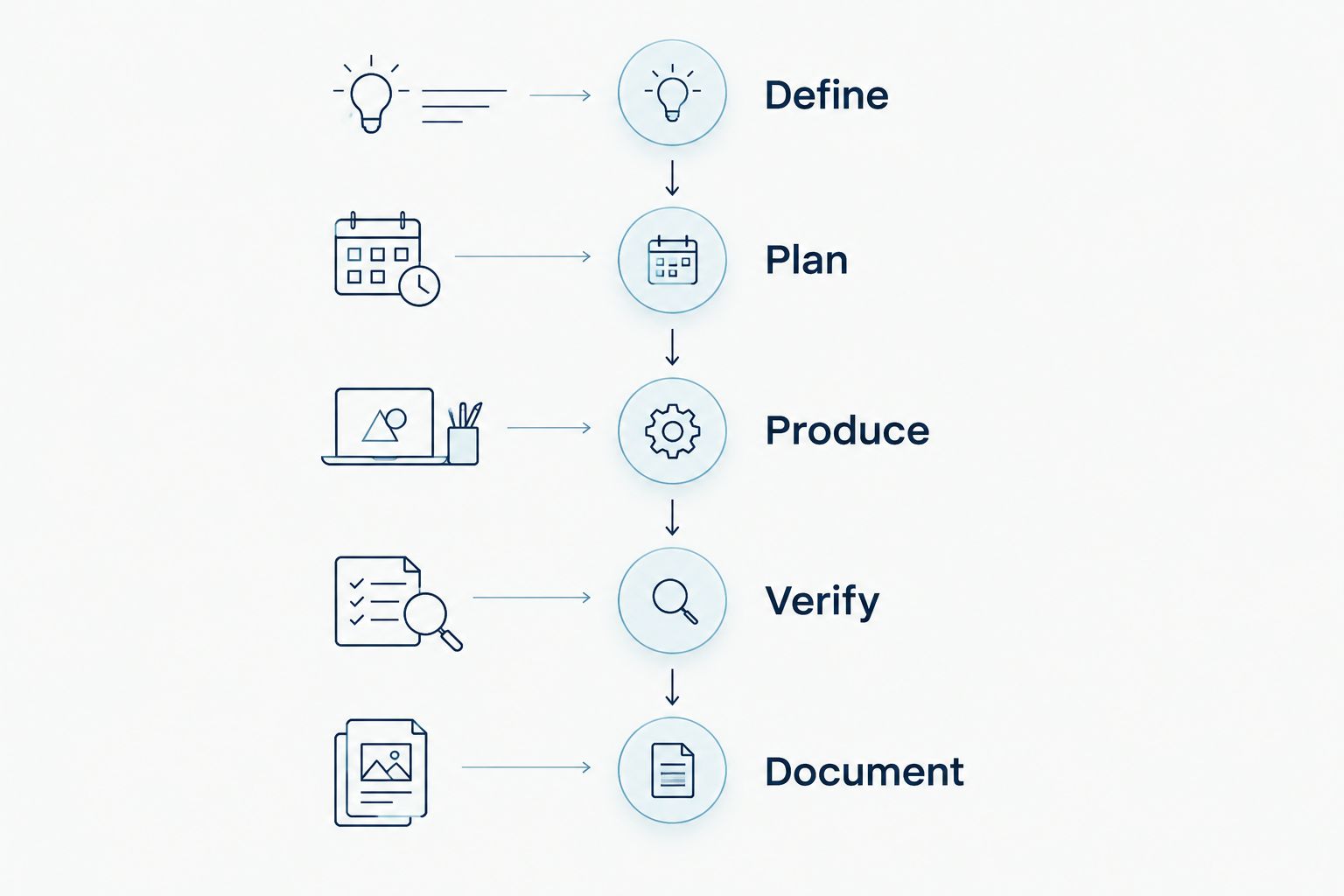
Define
Specify the target structure or material description, required form, intended laboratory application, and acceptance criteria. Identify which attributes are mandatory and which are exploratory measurements.
For a peptide, include the sequence and requested modifications. For other materials, supply the structural, compositional, or architectural definition appropriate to the project.
Plan
Agree on the synthesis approach, analytical methods, reporting package, and decision points. Name the person authorized to approve changes and establish what happens when feasibility work does not support the original specification.
Separate required deliverables from optional follow-up work. This prevents a proposal from appearing complete while leaving essential characterization outside its scope.
Produce
Require a traceable connection between the approved scope and the produced lot. Record agreed changes rather than treating substitutions or route adjustments as informal correspondence.
Distinguish development samples from material submitted for acceptance. Their documentation requirements need not be identical, but their status should be clear.
Verify
Assess each required attribute against its stated method and criterion. Review identity, purity, composition, and physical properties as separate questions where the project requires them.
A certificate of analysis summarizes reported findings. The agreed supporting records should explain how those findings were obtained and which lot they describe.
Document
Assemble the approved specification, relevant analytical records, lot identifier, deviations, and acceptance decision. Connect those records to your institution's laboratory and procurement systems.
For 2026 repeat orders, preserve the accepted specification version. A familiar material name is not sufficient evidence that successive orders share the same requirements.
How this shortlist is ranked
The order follows chemistry fit: defined peptides and small molecules, polymer architecture, inorganic phase and composition, then established-route transfer. It is a decision tree, not a claim that one provider category outperforms another across unrelated chemistries.
The criteria are specification fit, analytical relevance, lot traceability, change control, and research handoff. Reject a proposal when a required attribute has no agreed verification method. A detailed quotation cannot compensate for an undefined acceptance decision.
Which provider should you choose?
Choose Simple Life Science for a custom synthesis review when your research brief concerns peptides or small molecules. Choose a polymer or inorganic specialist when the defining requirement lies outside that molecular synthesis scope.
If you already have an established route and need a different production scale, prioritize a process-transfer brief. For an undecided buyer in 2026, the next move is to finalize the specification—not to expand the supplier list.
FAQ
What’s the best custom synthesis provider for materials science research?
The best provider is the one whose written scope covers your chemistry and acceptance criteria. Simple Life Science is a shortlist option for peptide and small-molecule projects; polymer and inorganic projects require a chemistry-specific review.
Can a peptide synthesis provider support materials science research?
A peptide synthesis provider can supply defined peptide inputs for a materials research project when the requested work falls within its agreed scope. Acceptance of the peptide input is separate from verification of the final material’s properties.
What should I send with a custom synthesis quotation request?
Send the target structure or material definition, required form, acceptance criteria, and requested analytical deliverables. Include relevant existing data and identify who can approve changes to the scope.
Is an HPLC purity report enough to accept a custom material?
An HPLC purity report alone does not establish every attribute of a custom material. Identity, composition, physical form, and other project-specific requirements need appropriate verification where they are part of acceptance.
How do I compare a polymer provider with a small-molecule provider?
Compare each provider against the required chemistry rather than treating the categories as interchangeable. Polymer projects need explicit consideration of architecture and distributions; small-molecule projects begin with a defined molecular structure.
What documentation should accompany a research synthesis lot?
The documentation package should match the approved written scope and identify the delivered lot. Specify the required analytical reports, methods, deviations, and acceptance records before production.
Can I use the same specification for a larger synthesis order?
Use the existing specification as the starting point, then review the proposed scale change. Define any required route review, additional checks, and comparability evidence before authorizing production.
One last thing
Ask the provider to identify which requested attributes will not be measured. That question separates a complete-looking document package from a complete acceptance plan.
An unmeasured attribute is not automatically a defect. It becomes a procurement problem when your research depends on it and neither party has assigned responsibility for verifying it.
Related guides
- Small-molecule synthesis companies for research laboratories
- Peptide sourcing for procurement teams
- Peptide analytical testing for QC teams
For laboratory research use only. Not for human or veterinary use. Not intended to diagnose, treat, cure, or prevent any disease.