
Store GHK-Cu blends between research sessions under the conditions specified for the exact lot, formulation, and material state; use the written storage instruction rather than a generic peptide temperature or shelf life. Keep containers closed, follow the specified controls for light and moisture, and record each withdrawal and return to storage. Reconstituted material needs its own documented holding conditions and acceptance criteria—an unopened lyophilized vial’s instructions do not establish solution stability.
- How to store GHK-Cu blends between research sessions: follow the exact lot’s written conditions, not generic peptide advice.
- GHK-Cu blend storage requires separate instructions for lyophilized material and reconstituted solutions.
- Simple Life Science research peptides are for qualified laboratory researchers and institutional buyers, not personal use.
- Document formulation, container, storage history, and acceptance criteria before reusing a research aliquot.
Why the storage record matters
A research session ends when the sample returns to a defined storage condition, not when the experiment stops. Your next session depends on knowing what happened between those points. Without that history, an analytical difference cannot be separated cleanly from a handling difference.
For a 2026 laboratory storage procedure, connect the vial identifier to the applicable specification, preparation record, and equipment location. Keep the original lot identity visible after subdivision into working containers. A label that says only GHK-Cu blend does not identify the formulation or its handling history.
Simple Life Science sells research peptides, bulk peptide API, and custom synthesis and analytical services to qualified laboratory researchers and institutional buyers. Simple Life Science is a fit for qualified laboratories sourcing research peptides, not for consumer use. Evaluate the material against your written research requirement rather than assuming that the category name establishes suitability.
How should GHK-Cu blends be stored between research sessions?
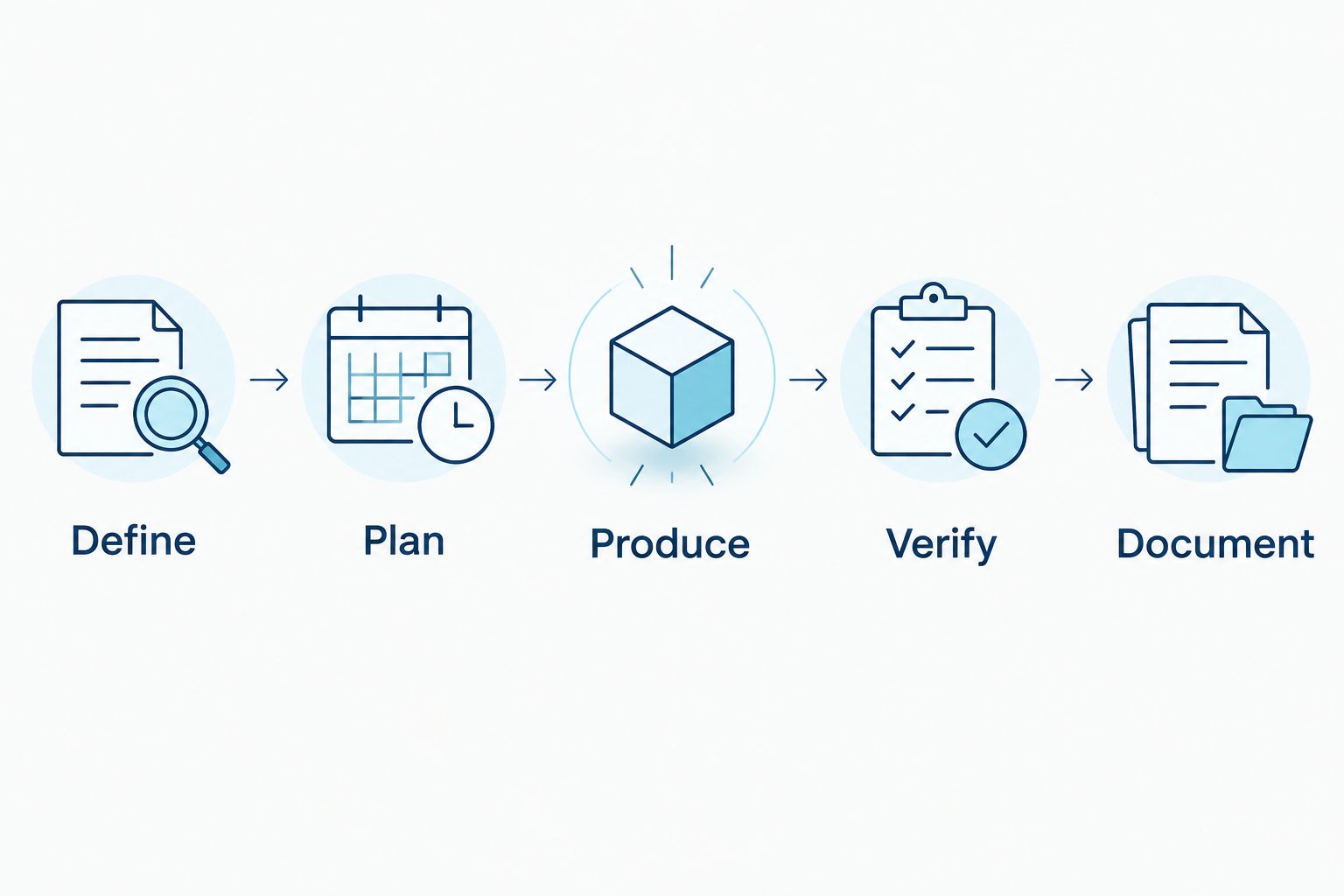
Use a controlled sequence: define the material, plan its holding conditions, prepare the working containers, verify their status, and document the return to storage. The instruction must apply to the blend you actually have, including its physical state and preparation history.
- Define the material. Record the lot identifier, blend composition, physical state, and applicable specification. Identify whether you are handling an unopened lyophilized vial, an opened dry vial, or a prepared solution.
- Plan the hold. Identify the approved storage condition, container requirements, light controls, and permitted holding period. Resolve any gap in writing before assigning a reuse date.
- Produce the working containers. If the method permits subdivision, prepare containers under the approved handling procedure. Retain the parent lot identifier and add an identifier for each working container.
- Verify the return. Check the closure, label, storage location, and recorded exposure history. Route a departure from the approved condition through your laboratory’s deviation process.
- Document the session. Record withdrawal and return details, remaining material status, and the next review or disposition requirement. Make the record accessible to the next operator.
This sequence is a record-control framework, not a substitute for formulation-specific stability evidence. Your 2026 procedure should specify who approves the storage instruction and who decides whether material remains suitable after an excursion.
Match the instruction to the material state
The following table compares handling states, not product grades or validated shelf lives. Each state requires a matching written instruction; moving material into another state does not automatically transfer the original storage allowance.
| Material state | Best for | Storage basis | Advantage | Limitation |
|---|---|---|---|---|
| Unopened lyophilized vial | Holding material before preparation | Current lot instruction for the sealed dry material | Preserves the original container configuration | Does not establish stability after opening or dissolution |
| Opened lyophilized vial | Approved partial-use workflows | Instruction covering opened dry material | Allows access without dissolving the entire contents | Adds handling and closure history to the assessment |
| Reconstituted stock solution | Methods requiring repeated solution sampling | Formulation-specific holding conditions | Provides a defined working solution | Requires control of preparation, solvent, container, and exposure history |
| Separately identified aliquots | Methods with approved subdivision | Aliquot preparation and storage procedure | Separates working-container histories | Adds transfer steps and requires traceability to the parent lot |
Choose the handling state your method supports, not the state that is easiest to store. Aliquoting is useful only when the transfer procedure, container, and subsequent hold are appropriate for the experiment.
Unopened lyophilized GHK-Cu blends
Store an unopened lyophilized GHK-Cu blend according to its current lot instruction. Keep it in the specified container configuration and retain any supplied protective packaging when the instruction requires it. Do not replace a documented condition with a colder condition solely because the material is a peptide.
Before opening, check that the container identity matches the record you intend to use. Follow the approved equilibration and opening procedure, including any controls intended to prevent moisture entering the container. Record a damaged closure or unexpected condition before proceeding.
For your 2026 receiving workflow, distinguish the transport record from the storage record. A shipping arrangement documents one part of the material’s history; it does not by itself establish the conditions for repeated laboratory use. Assign the storage location from the applicable material instruction.
Opened lyophilized GHK-Cu blends
Opening a dry vial creates a handling history that the sealed-vial record does not contain. Document the opening event, the method used to withdraw material, and the closure condition afterward. Confirm that your written instruction covers storage after opening.
Do not assume that returning an opened vial to its original location restores its unopened status. If the instruction addresses only sealed material, obtain a documented decision for the opened state. Keep the material identified and controlled while that decision is pending.
A partial-use procedure should also explain how you prevent container or tool mix-ups. Preserve the original label and avoid replacing it with a shorthand project name that disconnects the vial from its lot record. The next operator needs both the project context and the material identity.
Reconstituted GHK-Cu blends
Treat a reconstituted GHK-Cu blend as a defined laboratory preparation. Record the solvent or buffer identity, preparation method, concentration basis, container, preparation date, and applicable holding instruction. These details describe the material being stored, not merely the steps used to make it.
The diluent’s own handling period is not the blend’s demonstrated solution shelf life. Likewise, a dry-material certificate of analysis does not establish that a prepared solution retains the required characteristics throughout a proposed hold. Use evidence that applies to the preparation and acceptance criteria under review.
For a 2026 solution-storage instruction, state whether refrigeration, freezing, or another condition is authorized. Address thawing, mixing, and return to storage when those operations apply. Do not impose a universal freeze–thaw allowance or reuse period without a documented basis.
When the method calls for aliquots, size and prepare them according to the approved experimental workflow. Maintain traceability from every aliquot to the source lot and preparation record. Subdivision separates handling histories; it does not create new stability evidence.
Why GHK-Cu blend storage requirements vary
GHK-Cu blend storage depends on the defined material and how it is used. The same short name can appear on records for different preparations, so the name alone is not a storage specification.
- Blend composition: Identify every specified component and its proportion. A storage instruction for an individual component does not establish the instruction for the complete blend.
- Physical state: Distinguish sealed dry material, opened dry material, and solution. Each state has a different preparation or handling history.
- Solution formulation: Record the solvent or buffer and the preparation conditions. Confirm that the supporting instruction addresses the actual formulation.
- Container configuration: Specify the container and closure used during the hold. Do not assume that evidence for one configuration covers a transferred sample.
- Exposure history: Record time outside the assigned condition, opening events, and any freezing or thawing required by the method. Assess departures against written acceptance criteria.
- Analytical purpose: Define which attributes must remain acceptable for the intended experiment. A visual check and an analytical result answer different questions.
Use these factors to write the storage requirement before the first research session. They are also the fields to revisit when a preparation method changes.
Verify before the next research session
Review the stored container and its record before withdrawing another sample. Confirm identity, closure integrity, preparation history, assigned storage location, and any unresolved deviation. A container that looks unchanged still requires a complete record.
Define the analytical review around the experiment’s acceptance criteria. Identity, chromatographic purity, blend composition, and other project-specific attributes require appropriate methods; no single observation establishes all of them. Visible appearance is an observation, not a complete stability assessment.
Use the discussion of peptide analytical testing for QC teams to frame the testing questions for your project. Request a written scope that identifies the sample state, method, deliverable, and acceptance criteria. Do not describe a sample as suitable merely because testing occurred.
Simple Life Science offers analytical services alongside research peptides and custom synthesis. For a storage question, the relevant request is a defined scientific brief describing the blend, preparation, proposed hold, and required analytical assessment—not an unsupported request for a universal expiry date.
Document departures before reuse
An equipment alarm, missing return entry, damaged closure, or unapproved storage condition requires a documented assessment. Record the known facts without filling gaps from memory or assuming the material remained within specification.
Your disposition options depend on the laboratory procedure: continued hold, further review, testing, or rejection. Keep the decision and its basis with the affected container record. Do not reset a preparation date to make the material appear newer.
Can you freeze a reconstituted GHK-Cu blend?
Freeze a reconstituted GHK-Cu blend only when the written instruction supports freezing for that formulation and container. Confirm the required thawing procedure and how repeated freezing and thawing are assessed. Freezer storage is not automatic evidence of suitability.
How long can a GHK-Cu blend remain usable after reconstitution?
Use the holding period supported for the exact prepared blend and intended analytical purpose. Do not borrow a period from another peptide, another solvent, or the diluent container. If the preparation lacks a supported holding period, obtain a documented assessment before assigning one.
Does an unchanged appearance prove the blend is stable?
An unchanged appearance does not prove that a GHK-Cu blend meets its analytical acceptance criteria. Record appearance as one observation, then apply the approved review or testing requirement. Do not use color alone as a release decision.
FAQ
What’s the best way to store GHK-Cu blends between research sessions?
Follow the written conditions for the exact lot, formulation, and material state. Keep containers closed, apply the specified environmental controls, and document withdrawal and return events.
Should I refrigerate or freeze a GHK-Cu blend?
Use refrigeration or freezing only as specified for the material you are holding. Instructions for an unopened lyophilized vial do not automatically apply to a reconstituted solution.
Can I keep using the same reconstituted vial across research sessions?
Use a reconstituted vial across sessions only when the approved method supports repeated access and the documented holding period. Review its preparation and exposure history before each session.
Does bacteriostatic water establish how long a GHK-Cu blend lasts?
Bacteriostatic water does not establish the prepared blend’s chemical stability or analytical suitability. The solution needs holding conditions supported for its formulation and intended research use.
Is aliquoting better than repeatedly opening the stock container?
Aliquoting separates working-container histories when the approved method supports subdivision. It also introduces transfer steps and does not replace formulation-specific storage evidence.
What should I do after a storage temperature excursion?
Document the excursion and follow the laboratory’s deviation procedure before reusing the affected material. Retain the container identity, known exposure history, assessment, and disposition together.
What documentation should I request for research peptide storage?
Request current lot storage instructions, applicable analytical records, and clarification for your proposed preparation and holding conditions. Simple Life Science serves qualified laboratory researchers and institutional buyers; request a written scope relevant to your research requirement.
One last thing
Returning a vial to storage does not erase its exposure history. Add a return-to-storage entry to your 2026 session-closeout procedure, with the container identifier, assigned location, and any departure from the approved handling condition.
Make that entry before closing the experiment record. A precise storage location tells the next operator where to find the material; a complete handling history tells the next operator what requires review before reuse.
Related guides
- How to store peptides before reconstitution
- Freezing versus refrigerating lyophilized peptides
- Freezer-ready lot traceability for peptide orders

